Fast and Free Shipping Is Almost Pickup
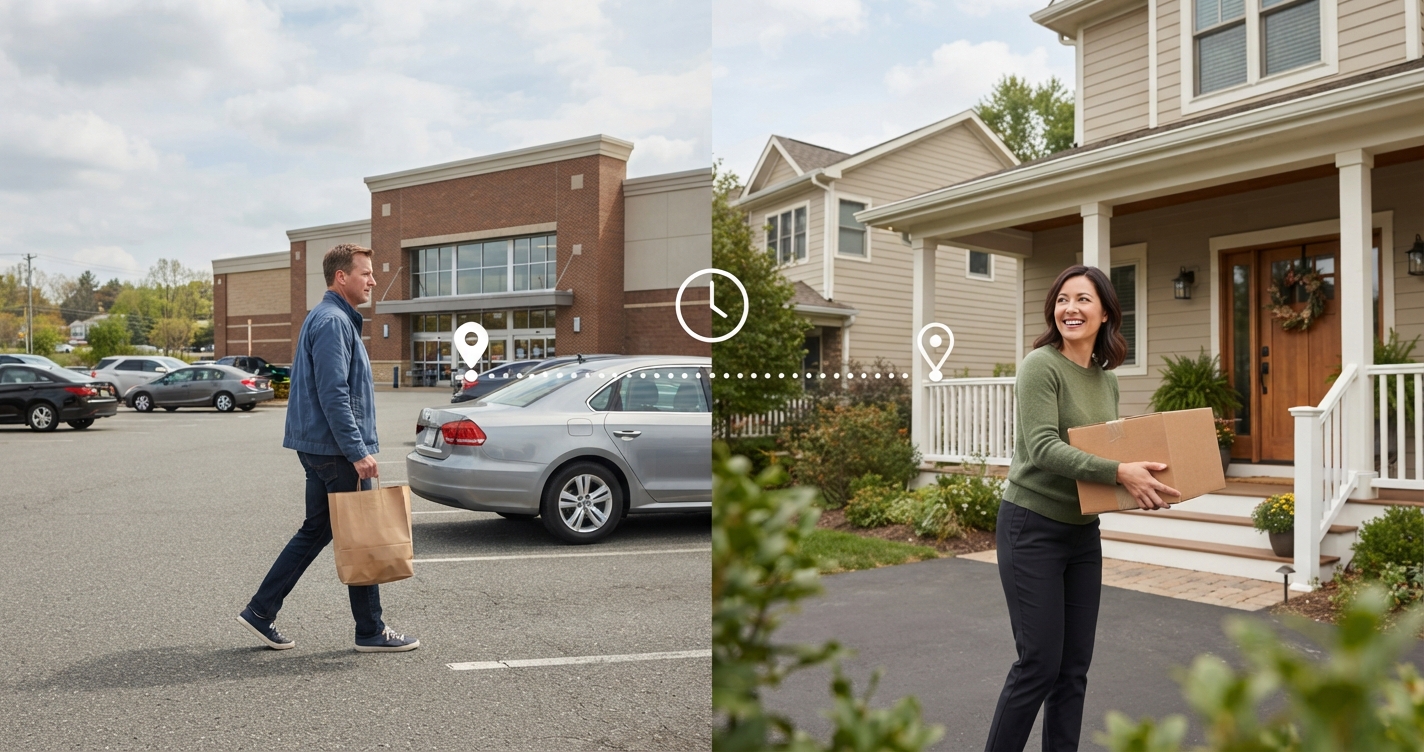
I spent a big chunk of my career betting on something else, and I'm sore about it.
So here's what I keep asking myself: if the store was already near you, how did a company with no stores get nearer?
Convenience is paramount, and I believe local, near you, should have been the fastest and easiest answer. Jeff Bezos bet on speed in 2005, when Prime launched with free two-day delivery on 1 million items. Over the next 20 years Amazon built the infrastructure to put merchandise near the customer. I lost that battle. I'm not ceding defeat, and here's my case: free next-day delivery is almost as convenient as pickup, and the retailer that spends on nearness can still win it.
What time and distance cost
We know the price of both now. Amazon puts a store trip at 51 minutes, an estimate it derives from the American Time Use Survey, and says its U.S. Prime members skipped an average of 64 store trips in 2025. That's the price of time. Amazon's footnote says it counts each day a member places at least one qualifying order as one store trip avoided, so take it as Amazon's own math, not an audit.
Distance is the other half. Amazon says its speed gains come primarily from placing products closer to customers. The box just starts its trip closer to your house. McKinsey saw the same thing industry-wide: average parcel delivery went from 6.6 days in early 2020 to 4.2 days in mid 2023.
Fast and free is nearly pickup
Pickup used to win on speed. You buy it, you drive over, you walk out with it today. Free next-day delivery takes most of that advantage away. In a FedEx and Morning Consult survey of 2,103 U.S. consumers, 40% preferred next-day home delivery from local retailers, against 19% for in-store pickup and 18% for curbside.
Think about what pickup costs you. You drive there, park, wait, and drive home. Delivery costs you the walk to the door. Pickup (retailers call it BOPIS, for buy online, pick up in store) still has one real edge, which is that you have the thing today. I believe that edge shrinks every time the box starts closer to your house.
Amazon's numbers point the same way. Prime members got over 8 billion items the same or next day in the U.S. in 2025, up more than 30%, and half of them were groceries and everyday essentials. That's stuff people used to run out and grab.
What a pickup costs you
Here's the math for an average person. The distance and time are my assumptions, so swap in yours.
-
Value of time: USDOT values local personal travel at 50 percent of hourly income. Applied to the $38.00 October 2026 average hourly earnings for private employees, that's $19.00 an hour. DOT's own method starts from median household income, so this is my adaptation.
-
Cost of driving: the IRS standard mileage rate is 76 cents a mile for the second half of 2026. That's a business rate, so I also show the 23.5 cent IRS medical rate as a low case.
-
Time: 15 or 30 minutes door to door for a pickup, or the 51 minutes Amazon estimates for a full store trip.
-
2 miles each way, quick pickup, 15 minutes: $4.75 of time plus $3.04 of driving is $7.79 ($5.69 at 23.5 cents a mile)
-
5 miles each way, pickup, 30 minutes: $9.50 of time plus $7.60 of driving is $17.10 ($11.85 at 23.5 cents a mile)
-
5 miles each way, full store trip, 51 minutes: $16.15 of time plus $7.60 of driving is $23.75 ($18.50 at 23.5 cents a mile)
For an average person, a pickup order costs about $6 to $24 in time and mileage before they've paid for anything. Free delivery costs nothing at the door. Nobody prices their own time this way at checkout, but it's a fair yardstick, and it's why I believe pickup has to win on right now, not on saving money.
The data that says I'm too simple
Here's where my argument gets tested. The surveys say people buy free first.
McKinsey found speed fell from first to fifth among delivery priorities between 2022 and 2024. In the same survey, more than 95% preferred free standard delivery over paid expedited, and about 50% said they would pay nothing for shipping at any speed. FedEx lands in the same place: 75% of consumers prioritize free shipping over fast shipping. And when Baymard asked why people abandon carts, extra costs came in at 40% and slow delivery at 20%, after setting aside shoppers who were just browsing.
Reliability beats speed too. McKinsey's respondents said they would rather wait up to a week for an on-time arrival than get a late one.
Two more cautions. These are stated preferences, and what people say in a survey isn't what they do at checkout. FedEx's own survey also found 55% would pay for same-day delivery and 45% for next-day, which cuts against McKinsey's 50% who won't pay anything. Surveys disagree.
And "free" isn't really free at Amazon. A Prime member has already paid for the shipping before the order. Amazon says U.S. members saved $550 on average last year, nearly four times the cost of an annual membership, and that members are using fast, free delivery to order meaningfully more often. At the $139 annual price Amazon lists, $550 works out to 3.96 times. But the release never says what counts as a saving. The only definition it gives is the time footnote above, and 64 trips at 51 minutes is about 54 hours, not the "over 55" Amazon states. Treat the $550 as an Amazon claim with no published method.
The sunk cost is still real. Once you've paid, a drive to the store feels like paying twice, and I believe almost nobody does that math at checkout. A retailer without something like it is asking customers to compare a prepaid order against a trip in the car.
So the fair challenge to my own title is this. Fast is a great add-on to free, and a weak substitute for it. Fast and free competes with pickup. Fast and paid doesn't.
Who paid for the nearness
We know how Amazon got nearer. It reinvested back into the business, and I believe it could because its shareholders were a different audience than the ones most retailers answered to.
Amazon told its shareholders in 1997 that it would favor long-term market leadership over short-term profit. The 1997 letter says investment decisions would be made "rather than short-term profitability considerations or short-term Wall Street reactions". It also says the company was running at a net loss, and that distribution center space grew from 50,000 to 285,000 square feet that year. Amazon has never declared or paid a cash dividend. The money stayed in the business.
Best Buy's shareholders got a different deal, and it's a legitimate one. In fiscal 2026 the company returned $1.07 billion to shareholders, $801 million in dividends and $273 million in buybacks. Its fiscal 2027 guidance has capital expenditures of about $750 million. Home Depot and Lowe's look similar. Home Depot's latest 10-K shows $9.15 billion in dividends against $3.68 billion in capital expenditures. Lowe's shows $2.64 billion in dividends against $2.21 billion in capital expenditures.
Then there are the two big retailers that went the other way. Target's fiscal 2025 release shows $3.73 billion in capital expenditures against $2.05 billion in dividends and $408 million in buybacks. Walmart's 10-K shows $26.6 billion in payments for property and equipment against $7.5 billion in dividends and $8.1 billion in buybacks. Both spent more building than they paid out. I believe that's why Walmart and Target are the retailers with a real answer to Amazon on nearness, and why a home improvement or electronics chain that pays out more than it builds has a harder time.
Here's the fair challenge. AWS earned $45.6 billion in operating income in 2025, more than North America and International stores combined at $34.3 billion. Retailers had no cloud business behind them. And today's spending isn't mostly about delivery: Amazon says free cash flow fell to $11.2 billion because purchases of property and equipment rose $50.7 billion, primarily for artificial intelligence. Also, this is one year of cash flow statements, and capital expenditures cover far more than delivery.
Why I'm not ceding defeat
Nearness is the product, and a store near you is the closest warehouse most retailers own. Amazon spent 20 years building what store chains already had, which is inventory close to the customer. McKinsey lists freeing up backroom space in local stores for online order fulfillment as one of the ways shippers got faster. FedEx's 40% for next-day delivery was specifically from local retailers.
I saw this up close. For a while, Best Buy shipped faster than Amazon. StellaService found that shipping from 50 of its 1,500 stores gave Best Buy delivery times that beat Amazon's over the 2013 holidays. I worked on that, and I'm proud of it. Retail Dive wondered at the time whether it was a fluke, and the lead didn't last. Also, that was shipping. I believe pickup was faster still, because the store near you skips the delivery leg completely.
Here's the challenge I owe myself. Owning the building wins nothing. Customers want it free and on time, and they never see where the box started. FedEx found 81% of shoppers will spend more to reach a free shipping threshold, yet only 48% of retailers offer free shipping at all. A retailer that treats every store as a free next-day node can compete. One that treats stores as places people have to drive to is playing Amazon's game on Amazon's terms.
I believe the retailer with a store near you still has the best shot at winning this, as long as the delivery is free and the company spends like Walmart does on getting nearer.
If you run stores, which of your pickup orders could have been a free delivery tomorrow?