Get it by: parcel shipping from every store
The problem
As the product manager for inventory, payments and fulfillment on Best Buy's digital channel, I tracked how inventory turnover flows through to earnings per share, and the numbers bothered me. Units sat in stores and warehouses, hidden from online customers by rules that each made sense on its own: safety-stock floors, third-party fulfillment rules, clearance status. Together they stranded inventory that online customers wanted to buy.
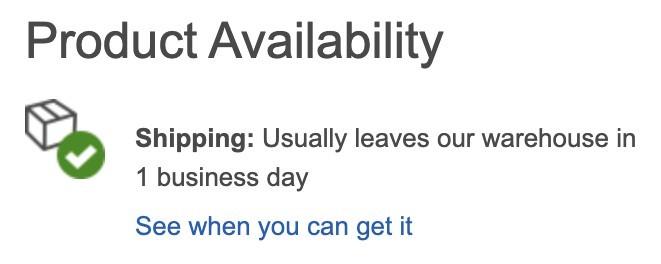
The units shoppers could buy came with a vague promise. In 2014, a laptop page said it "usually leaves our warehouse in 1 business day," and the arrival date took another click. Vendor-shipped items carried a flat 10-day promise, however fast the vendor actually shipped.
What I saw
Customers can't buy what they can't see, and they won't buy a date they don't believe.
Every store was already a warehouse, paid for and close to customers. What was missing was the sourcing logic to ship from it, and a date built from the same data: where the units were, where the customer was, and carrier transit time between the two.
What I built
Sourcing: ship from every store. I led the Ship-from-Store pilot, starting with 50 underperforming stores, and iterated on sourcing rules one SKU at a time:
- Third-party SKUs sitting as returns on store shelves: check on-hand store inventory first. Nearly all of it shipped within a week.
- Clearance SKUs: remove the safety-stock floors and sell down to the last unit. If one store can't pick it, the next store does.
- Items dropped from a single store's planogram: ship them out the back door instead of letting them sit.
- Open Box: enable it for Ship-from-Store, so stores could sell returns directly.
The sourcing logic, which picks the fulfillment location by transit time and cost, is patented: U.S. Patent 10,636,079, Demand-Based Product Sourcing (2020).
The date: "get it by" instead of "usually leaves our warehouse."
- Regional availability: carrier time-in-transit from the warehouse serving the shopper's region, plus their ZIP code, plus real-time available units, produced a personal date instead of a flat promise.
- Ship-from-store: once stores became origins, the nearest store with stock could set an earlier date.
- Same-day shipping: shown only when a nearby store could actually meet it.
- Vendor-aware dates: for vendor-shipped items, the date used where each vendor's warehouses were, the units in each, and that vendor's real processing time. Slower than Best Buy, still faster than the flat 10 days implied.
- Proven at checkout, then moved up the funnel: dates launched in checkout, where the signal was clearest, then cart, the product page, the listing page and finally search, aligning two separate search teams.
The result
- In the 2013 holiday season, with the first 400 stores shipping, StellaService measured Best Buy's average shipping time at 3 days to Amazon's 4.
- Ship-from-Store scaled from 400 to 1,417 stores in one year, all 1,050 Best Buy big-box stores plus 367 Best Buy Mobile stores.
- In August 2014, Best Buy's CEO said ship-from-store drove over half of online sales growth for the second quarter in a row. Best Buy's results cited it in a 29% increase in comparable online sales that spring, and a 21.6% rise in the third quarter "due to substantially improved inventory availability made possible by the chain-wide rollout of our ship-from-store capability."
- By March 2015, online had grown from 7% to 9.8% of domestic revenue, with ship-from-store chain-wide.
- By November 2015, Best Buy credited faster shipping enabled by ship-from-store, as online comparable sales rose 18% on higher conversion rates.
- In 2014, UBS estimated bestbuy.com drew over a billion visits a year, and only about 1 in 100 visitors bought.
- The growth came from shoppers who were already there buying more often. Best Buy's fourth-quarter fiscal 2016 results attributed a 13.7% rise in online revenue "primarily" to higher conversion rates.
- Vendor-shipped items grew from about 10% to about 15% of ship-to-home units.
What I learned
The biggest opportunities live in the gaps between teams. Stranded inventory wasn't a store problem or a digital problem, and a vague date wasn't a supply chain problem or a website problem. Both sat in between, waiting for logic.

- Best Buy Q2 fiscal 2015 earnings call, August 2014 (ship-from-store over half of online sales growth)
- Best Buy Q1 fiscal 2015 results (comparable online sales +29%)
- Best Buy Q3 fiscal 2015 results (rollout from 400 to 1,400 stores; comparable online sales +21.6%)
- Best Buy Q4 fiscal 2015 earnings call, March 2015 (online 7% to 9.8% of revenue)
- Best Buy Q3 fiscal 2016 earnings call, November 2015 (faster shipping enabled by ship-from-store; online comps +18%)
- Best Buy Q4 fiscal 2016 results (online revenue +13.7%, primarily due to higher conversion rates)
- Forbes (Trefis), June 2014: Best Buy To Benefit From Increasing Online Sales (UBS estimate of visits and conversion)
- Motley Fool, February 2014: Best Buy Ships Faster Than Amazon? Really?! (StellaService, 2013 holiday season)
- Retail Dive, January 2014: Ship-from-store gives Best Buy an edge over Amazon
- Best Buy fiscal 2015 Form 10-K (1,050 Best Buy stores, 367 Best Buy Mobile stores)
- Screenshots via the Internet Archive Wayback Machine (October 5, 2014) and bestbuy.com (October 2026)