Google Already Showed Us How Compute Demand Behaves
What do you feel when you read that Alphabet plans to spend $195 to $205 billion on capex (capital spending) this year? Mostly I feel a little strange about it - but I shouldn't.
As an investor, that's a lot of cash heading out the door. As someone who could end up living next to a data center someday, same nerves. I keep thinking about the last time a company had to build computers faster than the world could ask it questions. That was Google, and its numbers say something I don't hear much right now.
My hypothesis: the compute AI uses per person will climb faster than it did with search at Google, and the total will follow. Reward loops will keep people coming back to their AI, again and again, to solve problems. I could be wrong, and I'll show you where I think it breaks. First the history.
Before Google: a crowded field and a first hockey stick
Search demand went vertical before Google existed. In 1994 the World Wide Web Worm answered about 1,500 queries a day over 110,000 pages. Lycos launched out of Carnegie Mellon that July with a catalog of 54,000 documents. WebCrawler served its one millionth query in November. Then everybody piled in: Excite, Infoseek, HotBot, and metasearch tools like MetaCrawler that did nothing but ask the other engines. Five of them paid $5 million a year each just to rotate on Netscape's search page - the web browser that changed the world.
Yahoo was the champion, and it scaled with people. It began in January 1994 as a human-edited directory. By December 1998 its properties were serving about 167 million page views a day, with web-wide results from Inktomi bolted on for when the directory had no match. In August 1999 Danny Sullivan read the Media Metrix numbers as Yahoo at its highest share ever, about 46% reach. I guess a directory has a ceiling. Humans only classify so many pages.
AltaVista showed both the demand and the bill. It opened on December 15, 1995 with 16 million documents when rivals were indexing one to two million. More than 300,000 people used it on day one. It ran on DEC's Alpha 8400 TurboLaser, launched as a showcase for hardware DEC wanted to sell. By 1998 it took 20 multiprocessor Alpha machines with 130 GB of RAM and 500 GB of disk to serve 13 million queries a day. The sources don't agree on daily volume, so treat those as ballpark.
So when Google put its cork board PCs in a rented cage in 1999, nobody had to be convinced that people would search. The open question was who could serve it cheapest. AltaVista served the first wave on big iron. Google served the next one on cheap PCs and software that expected to lose a machine a day. That's the pattern I'd bet on for AI too. The demand is already proven. The fight is over who builds supply at the lowest cost per answer.
It all looked a little silly at the time. Ask Jeeves and a long list of other engines were flashes in the pan, and every one of them had compute power behind it. The herd thinned anyway, and Google prevailed. I think AI is the same tale. Many models and platforms today, and I believe the herd thins again. That's the part that should worry an investor. Demand can be real while a lot of the compute built to serve it ends up on the losing side.
A cork board and a hockey stick
Google started with about 30 PCs on cork board shelves in a rented cage. In 1999 it had 112 servers, then placed its biggest order yet: 1,680 servers for about $109,000. Urs Holzle, who built Google's infrastructure, said that by summer those racks were running search for millions of users.
Demand showed up fast. About 3 million searches a day in August 1999. Then 18 million in the first half of 2000 and 60 million in the second half. Google engineer Jeff Dean described that stretch as traffic growing roughly 20% a month, and the answer was to keep adding machines.
Then 200 million a day in 2004. More than a billion a day in 2009. About 100 billion a month in 2012. More than 5 trillion a year now, around 14 billion a day. From roughly 10,000 a day in 1998, that's more than a million times, by my math.
Supply kept pace, by Dean's account. In a 2009 talk Dean said that from 1999 to 2009 Google's query volume rose about 1000x and its processing power rose about 1000x. Answers got faster too, from around a second to under 0.2 of a second.
One more number from that talk. A single query touched about a dozen machines in 1999 and around 1,000 by 2009, because Google put the whole search index in memory. Nobody forced it to spend more compute per question. It did, because speed is what makes people ask again. That's my read, anyway.
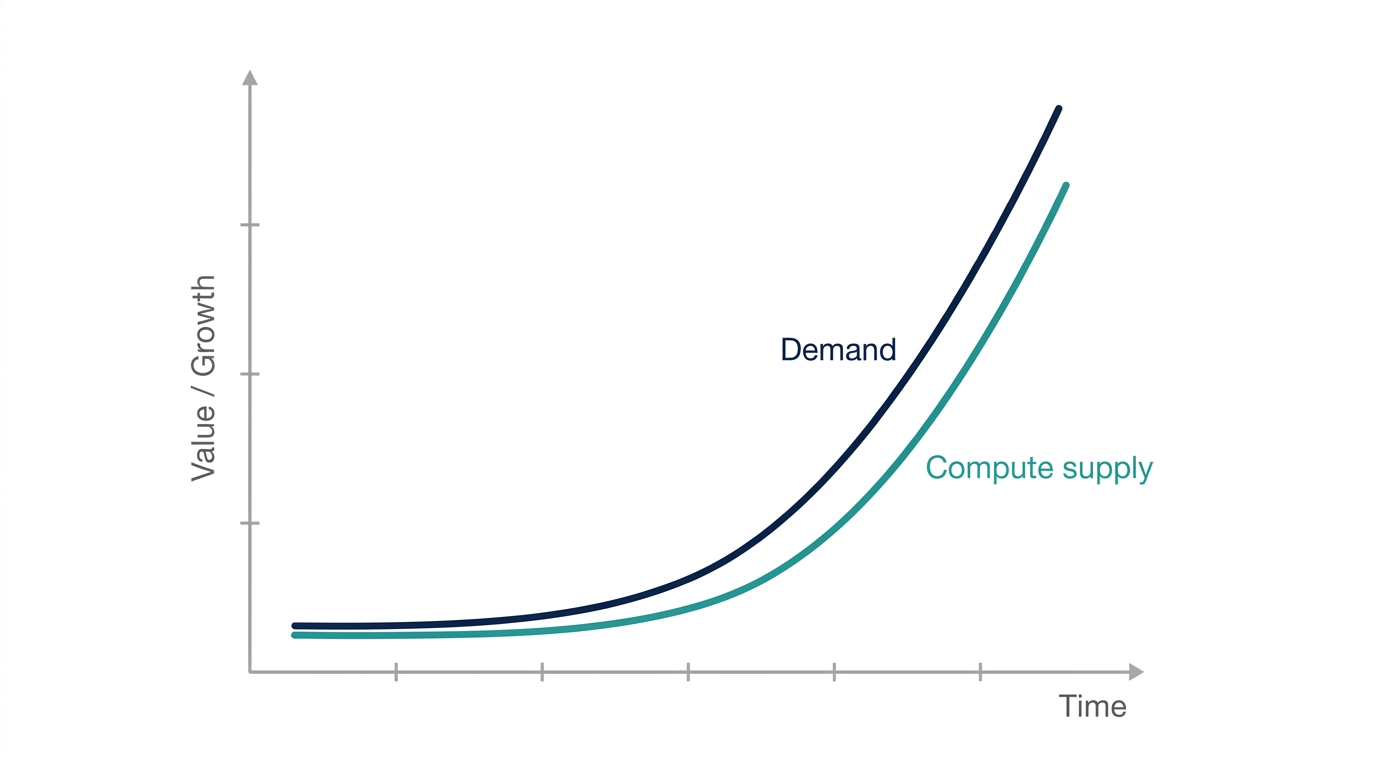
Here is the demand and supply side by side:
-
1999: About 3 million searches a day. Supply: 112 servers, then an order of 1,680 for about $109,000.
-
2000: 18 million a day rising to 60 million; traffic up roughly 20% a month. Supply: about 1,000 dual-processor servers, adding machines constantly.
-
2004: 200 million searches a day. Supply: at least $250 million of capex planned for the year.
-
2009: More than 1 billion a day. Supply: processing power up about 1000x in ten years.
-
2012: About 100 billion a month. Supply: $21 billion spent on its own data centers from 2006 to Sept 2013.
-
2013: Dean's voice search napkin math. Supply: work starts on Google's own AI chip.
-
2025: More than 5 trillion a year. Supply: $91.4 billion of capex.
-
2026: 3.2 quadrillion AI tokens a month. Supply: $195 to $205 billion capex guided.
When the curve outran the hardware
In 2013 Dean did a napkin calculation that scared Google. If hundreds of millions of people talked to their phones for just three minutes a day using its improved speech recognition, Google would need to double the number of computers in its data centers. Double the fleet, for one feature.
Google didn't just write a bigger check. It built its own chip, the Tensor Processing Unit (TPU), and had it running in data centers in 2015, about 15 months after the project began. Google reported that the first version ran 15 to 30 times faster than the standard chips of the day. Supply followed demand, but it took invention to do it.
Same curve, new numbers
Google's AI usage looks like the early search chart, only steeper. Tokens are the small chunks of text a model reads and writes. Google processed about 9.7 trillion a month in April 2024, 480 trillion in May 2025 and 3.2 quadrillion in May 2026. That's roughly 330 times in two years. By Q3 2026 its model APIs were running nearly 32 billion tokens a minute, more than four times a year earlier. The Gemini app passed 1 billion users and Cloud revenue grew 103% to $30.7 billion. Sundar Pichai said Search query growth was the highest in five years, and Google's newest model ramped 3.5 times faster than the one before it even with capacity tight.
A caution on those numbers. They're Google's own and unaudited, and tokens measure how hard the machines are working, not how many people are using them.
Supply is chasing it the same way. Alphabet's capex was $24.6 billion in 2021, $31.5 billion in 2022, $32.3 billion in 2023, $52.5 billion in 2024 and $91.4 billion in 2025. The 2026 guide is $195 to $205 billion, and Q3 alone was $51.4 billion. Amazon, Microsoft, Alphabet and Meta spent about $410 billion combined in 2025. In Q3 2026 alone they spent $201.9 billion, up 108% from a year earlier.
In November 2025 Google's AI infrastructure chief, Amin Vahdat, told employees the company has to double its serving capacity every six months, about 1000x in four to five years. Google says that gets there through better chips and more efficient models as well as new buildings, and the stated goal is the same cost and increasingly the same power. That last part matters to those of us who might live next to one of these. If Google gets its way, demand can double without the power draw doubling.
Notice the gap between demand and spend. Tokens rose about 330 times in the two years to May 2026. Alphabet's capex went from $52.5 billion in 2024 to a 2026 guide of about $200 billion, under four times. Better chips and more efficient models absorbed most of the growth. I think that's the real answer to the investor in me: demand can run far ahead of spending. It's also the risk, because cheaper tokens only pay off if people use many more of them.
Why I think the reward loop makes it steeper
Search was ask, get an answer, done. AI is ask, get an answer, ask again. I believe that loop is stronger than search ever was, and the faster the answer comes back, the stronger it gets. Google saw the same thing with speed in search: a 400 ms delay cut searches per user by about 0.6%, and the loss grew the longer people lived with it. I believe AI will learn the same lesson, and speed will push compute demand higher. Agents chain many model calls, so latency compounds across every step. Faster answers mean more asks. Faster inference can also cut the compute per answer, so I'm betting on volume, and I could be wrong. Search grew because more people searched. I think AI grows on a second axis too: the same people coming back every time they hit a problem.
Questions are a simple start. They're the tip of the iceberg, and below the waterline are all the other ways AI will show up in a person's life and work. Google already says queries are getting longer and more multimodal, and one in five AI Mode searches now use voice, images or documents. So I think per person consumption of compute goes up.
Most of that work won't need a frontier model. Models are transmissions, not engines. Today you pick the gear yourself, like manual transmission. I think the future system picks it for you, like automatic transmission, and a lot of the work gets done in fifth gear, cheap and efficient. Cheap work gets done more often.
Where the comparison could break
Fiber is the honest counterexample. In the late 1990s telecom companies buried fiber for traffic that didn't show up on schedule. More than 60 of them failed between 2001 and 2003, and four years after the bust 85% to 95% of that fiber was still dark. It did get used eventually. If I'm wrong, that's probably how: the demand arrives, just not on the schedule the check was written for. An investor who was right about demand and wrong about timing still lost the money.
Today's capacity looks spoken for. Google Cloud's backlog was $561 billion at the end of Q3, and Microsoft reportedly has $80 billion of Azure orders it can't fill because of power. Those are contracts, though, not usage.
Search paid for its own servers. AI hasn't proven that loop yet. Every search query carried an ad. In Q3 Search and other ads grew 12% while Pichai said query growth was the fastest in five years. More questions don't automatically mean more dollars. Bank of America forecasts hyperscaler debt issuance of $175 billion in 2026, against a $28 billion yearly average over the prior five years. That's the part that makes the investor in me squint.
The number I'm watching is revenue per token. Capex only tells me what Google is betting.
Where I land: the demand looks valid to me, and I'm betting per person use keeps climbing. Whether it pays for itself, I can't tell you yet. Revenue per token will.