Would you wait 7 minutes behind someone at a coffee shop?
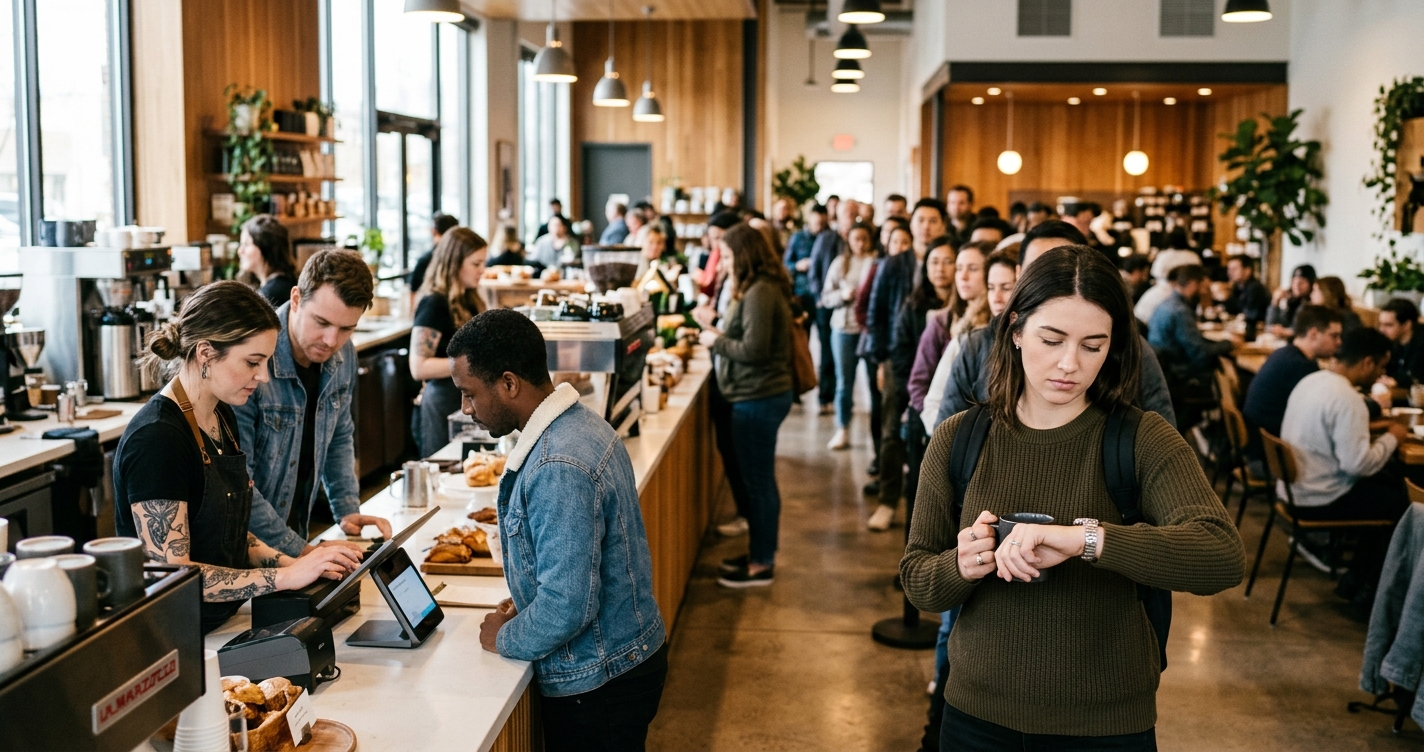
Picture the line. The person in front of you is ordering a latte, and the cashier is typing their name, phone and email into the system. Seven minutes later they're still typing. You're looking at your watch.
My argument: slow new-customer entry is a line problem before it is a data problem. Every minute at the register costs the shop twice, once in labor and again in the customers who never get a turn.
Here's a theoretical version. Say a point of sale (POS) platform has six places where staff can create a new customer: the register, a handheld, the back office and a few others. Say product analytics shows the average create takes 2 minutes on the best surface and 7 on the worst. A task that should take seconds. These are illustrative numbers, not from any real company.
A caution on the numbers. These are averages, and a few very long creates pull an average up, so the median is smaller. The labor math below still uses the average, because payroll pays for total minutes, and total minutes is customers times the average. Even so, the point holds. Half of the customers still waited longer than the median, and nobody would call that number seconds.
The labor
The Bureau of Labor Statistics (BLS) says the median cashier earned $15.81 an hour in May 2025. Wages are about 70% of what an employer actually pays once benefits are counted, so call it $22.59 an hour loaded ($15.81 / 0.70), or about 38 cents a minute.
-
2 minutes: 75 cents per new customer
-
7 minutes: $2.64 per new customer
-
Under 1 minute: 38 cents per new customer
Pennies, until you multiply. Per 1,000 new customers, the 7-minute surface burns 117 hours of staff time and about $2,636. At under a minute it's 17 hours and about $376. That's roughly $2,260 per 1,000 customers, and a merchant adds a lot more than 1,000 over a year.
And the labor number is the small one. The bigger cost is the line. In a Forrester survey of 1,000 U.S. shoppers, 39% said they had left a store without buying because of long lines, and more than half said they would spend less or walk away to avoid slow checkout. Digimarc, which sells checkout technology, commissioned that 2018 study, so treat it as a signal, not a benchmark. Nobody wrote a review about how nicely the merchant entered their email address. They complained about the wait.
Faster orders, shorter line
Ever walked into a shop, seen the line, and walked right back out? Same with a drive through. One look at the row of cars and you keep driving.
Queueing theory has a rule for this, and the math is simple. Little's law says the number of people in a system equals how fast they arrive times how long each one stays. Cut the time each order takes and the line shrinks, with no change in how many people show up.
A shorter line also pulls people in. Every person who walks out never gets asked for a name or makes a sale. The customer we lose to the line is the one we never get to meet.
Who signs up when it takes seven minutes?
Back in the coffee shop line. How likely is anyone to hand over their phone number and email while ten people wait behind them? My bet is lower, and I'd want the sign-up rate to prove it. Most folks will wave it off and just pay.
The less friction, the more likely people are to start the relationship. Twenty seconds for a name and a phone number feels like nothing. Seven minutes feels like a favor.
And the relationship is the point. A customer in the system is someone the shop can thank and send an offer to. More relationships means more repeat visits, and more repeat visits means growth. That's my belief, and a shop can measure it: how many customers get asked, and how many say yes.
The fair challenge: a faster form could mean a rushed cashier and sloppier data. Maybe. So track errors next to time, and don't trade one for the other.
A second challenge: some customers say no no matter how fast the form is. Handwave surveyed 2,001 U.S. consumers and found 57% instinctively refuse when asked for their email at checkout, and 24% refuse every time. Cloaked found that 89% of Americans refuse to share their real phone number or email in at least one everyday situation. Both companies sell privacy or biometric products, so they have a stake. Handwave reads its own result as a refusal of a clunky, low-value exchange, which fits my argument, but that is their interpretation, not a finding. I found no public benchmark tying form time to sign-up rate, so that link stays my belief until a shop measures it.
What we can do about it
Now say a team rebuilds the create flow. My belief is the average can get under 1 minute with the median even less. That's the target worth measuring, and I'd want the data before calling it done. For me, "iterate to great" (I credit Carla Vernon with this gem, which I use nearly daily) is the way forward. Small friction can be removed (defaulting country code based on merchant address, email address domain autocomplete, customer self-service on phone pre-post purchase, etc.) to reduce times further. Everybody wins - the cashier's work is less tedious, the customer gets what they wanted faster, and the local coffee shop grows thanks to the additional customer relationships.