The Decision Registry: Shared AI Memory for Enterprise Projects
My personal AI knows me well, and I control what it remembers. That AI memory is one of the best things about using it. I can tell it to remember something, review what it has stored, and delete what I don't want kept.
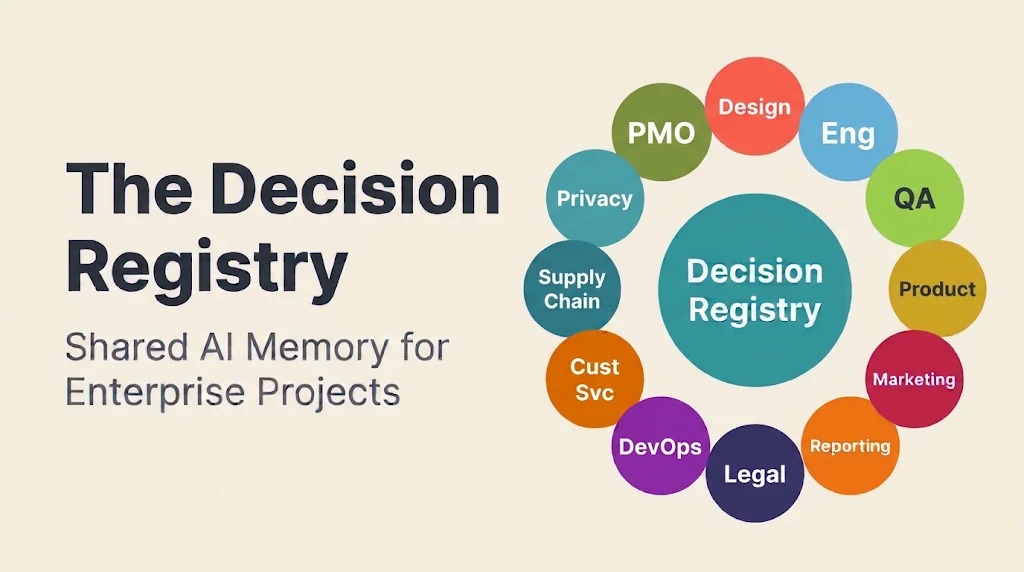
At work, enterprise AI has no equivalent for the project. Everyone around me on the same project uses AI, and none of those assistants share memory or share the decisions the project has already made. A shared decision log that every AI client can read and write closes that gap. I call it a decision registry.
AI has memory about the person. It may not have memory of your project, or of your enterprise project.
Search finds what was written down
Search helps. AI can find internal documents, and it can see Slack, Teams and email. Search finds what was written down. A document can capture an hour of discussion. A decision is the one line that records what we settled. What's missing is a shared home for the decisions themselves.
Where the name comes from
The name comes from my Microsoft days and the Windows registry, the hidden store of settings that would overwhelm users if they all surfaced in Control Panel, and that applications write to as well. I opened regedit daily back then. Clunky. The idea held up: one governed place that everything reads from and writes to.
My work in the semantic layer shaped this thinking. A semantic layer defines a metric once, and every tool that asks reads the same definition. A decision registry applies the same discipline to decisions.
What goes in a registry
Every project can have a registry of its decisions. Architecture, design, product, engineering and devops decisions all belong in it. Architects will recognize the decision log, and ADRs (architecture decision records) have served that purpose for years. The registry extends the idea beyond architecture and is built for AI to read and write.
Others are building pieces of this. Decision memory tools for coding agents exist, and AI meeting assistants already pull decisions out of transcripts. What I haven't found is the whole loop across disciplines: enterprise, project and product decisions, certified by the program team, and read by every client. I could be wrong about that, and I'd welcome being pointed to anyone who has built it.
Three levels, one registry per project
Decisions live at three levels: enterprise, project and product. Each project gets its own registry, served by its own MCP (Model Context Protocol) server. MCP gives any AI client a standard way to read from and write to a shared source. An enterprise can run many registries side by side, and each one is disposable when its project completes.
Decisions that cross disciplines
The value is in decisions that cross disciplines, because the people on the other side rarely see them. Design standards matter to front-end engineering. Put them in the registry once, and the design client and the code client start from the same page.
Take a simple design decision: errors never rely on color alone. That decision shapes the error copy product writes and the cases QA tests. Neither is an architecture decision, so neither would ever receive an ADR. The designer knows. The person writing the story may never hear about it.
Multilingual support works the same way. Product decides which locales ship. That one decision tells UX how much room the text needs and tells front-end engineering what to build in from day one. Some languages run longer than English, and some read right to left. Translation comes later, and at U.S. Bank the compliance team owns it. Those stakeholders need the registry too.
More examples, grouped by level:
-
Enterprise decisions
- Legal decides French must be the default, because the law requires it (Quebec's Charter of the French language). Product, UX and front-end engineering all have to build for it.
- Legal also decides that some states have special laws, so the terms and disclosures change with the customer's state. Product decides when each version shows, front-end engineering renders it, and QA tests every state.
- Compliance decides that 100% of the people who interact with the experience must be able to access it. That's the accessibility standard design, front-end and QA all work to.
- HR decides no one is scheduled for fewer than 10 hours between shifts. Product has to enforce it in scheduling, front-end engineering has to show the conflict, and reporting has to track every exception.
-
Project decisions
- Architecture decides on Lit for the mobile apps. Design needs to know that before the first screen is drawn.
- Reporting decides every clickable element needs a named event for measurement. Design and front-end engineering have to name every one of them.
- The project decides one person can hold more than one role. A shift is assigned to a role, and compensation is tied to the role, not the person. Scheduling has to ask which role the shift is for, payroll has to pay by the role, and reporting has to cut labor by role.
-
Product decisions
- Marketing decides the page must support schemas for SEO (search engine optimization) and AEO (answer engine optimization). That lands on front-end engineering, because the markup has to be in the page.
- Checkout decides customers can buy as a guest, with no account. Marketing loses the automatic email capture, reporting can no longer count repeat customers by login, and front-end engineering builds the lighter form.
- Order management decides a customer can cancel an order only until it's released to the warehouse. Front-end engineering decides when the cancel button goes away, customer service writes the "too late" answer, and reporting counts cancels separately from returns.
Walk the org chart and every area holds enterprise, project and product decisions, in some mix. Risk, compliance, legal, tax and HR belong in the registry next to design and engineering, so everyone downstream starts from the same decisions.
Getting decisions in
Some decisions are already written down. Convert them to a machine-readable format. Others live in someone's head or in a meeting nobody recorded, and those get written down first.
The registry updates itself after the meeting. When someone publishes the notes, the AI that generated them updates the registry in the same step. Nobody files anything by hand.
Stage gates and certification
Decisions need stage gates, like any other work product. The AI creates a draft right after the meeting. The program team reviews and certifies it, which makes it settled for every client and every person in the effort. Leadership owns certification and welcomes challenges. Anyone can raise an open question, and the AI logs it against the decision where the whole team can see it. Think of it as governance for the context AI works from.
Consider the cycle time. You meet Tuesday at 2 PM, decide at 2:30 PM and route the decision to the program team at 2:31 PM. They certify it by noon the next day. At 12:01 PM Wednesday, the people and the technology around the project work from that decision, and the design, the code and the tests all come out righter.
Who decided this, and why
"Who decided this, when, and why?" gets sunlight. The context of the decision is attached to it, so the answer sits on the decision itself.
Surfacing decisions empowers everyone. They're democratized and understood. The context travels with the decision, and anyone can ask it questions, as in the trusted answers prototype.
Some people will sit and browse the registry, and that's fine. The value is in how enterprise, project and product decisions become useful for everyone. Decisions trapped in source code are elevated for anyone who wants to see them.
Starting from existing code
A product with an existing codebase already has decisions inside it. The first version of its registry is a baseline an AI agent surfaces from the code: the rules, configs, feature flags and schemas, with the rationale marked missing. The why may not need filling in at all. The baseline simply elevates decisions already memorialized in code.
A baseline also invites challenges, and they can come from anywhere. Someone in marketing reads the schema and asks: "Why don't we ask for a customer's birthday at sign-up?" The decision, as reflected in the schema, is that we don't store one. The challenger explains: when we know the birthday, we can send a special offer to celebrate it. The challenge routes to the product manager, who now has a concrete question to weigh: what would a birthday offer be worth to customer retention and engagement, against what it costs to collect and protect the data? Early on, challengers won't be expected to quantify that value, because most people don't work this way yet. Over time, the registry can ask more of them, and a challenge arrives with the value it expects attached.
Meetings get meatier
Meetings gradually get meatier. We make decisions. We challenge decisions. Decisions are there for everyone across the enterprise, the project and the product to see. We meet less on status and more on the decisions, and we spend more of our time improving.
Challenges can come from anywhere. Say customer service keeps hearing from customers who can't cancel an order once it's released to the warehouse. They challenge the order management decision, and the challenge is logged against it with what they're hearing, where the program team sees it. Here the value is easy to attach: say 18% of the calls received are categorized as "can't cancel my order." That is a share of call volume the program team can weigh against the cost of letting customers cancel later.
Every AI client reads it
Without a source of truth, AI returns answers that are confidently wrong. It is trying. It does not know what the project knows. One person corrects it, the next person corrects theirs, and both corrections stay in chat windows that never connect.
Now extend the registry to every AI client the team touches: Figma Make, Copilot, GitHub Copilot and whatever comes next. Each client reads the certified decisions before it acts. Every client compounds in value. The initial design is righter. The story is righter. The acceptance criteria are righter. The code is righter.
Velocity and quality both accelerate. We CAN have better, faster and less expensive at the same time.
The work finally reflects what we actually do. We meet, we make decisions, and the technology works from them, compounding in value.
The gap I see
My belief: most enterprises don't yet have this shared decision layer. Leaders are right to ask for more with AI. Enterprise architecture may not yet have guidance on how a product, a project or an initiative stands up a decision registry. That's the gap, and I think it's the next one to close.
I believe this is also an opportunity for ServiceNow, Microsoft or any enterprise computing vendor. Whoever offers the decision registry as part of the enterprise stack gives every project a place to start.
You'll be surprised by what happens once one exists. If your team already has a decision registry, or is considering one, I'd love to hear what you call it.