Here We Go Again: Automation Fears from 1961 to AI
I just landed a new job, and every other article in my feed says AI is coming for people like me. Sound familiar? It should, because people were saying the same thing about machines in 1961 and about computers in 1965.
I went and read what Time magazine actually wrote back then. The tools changed, but the fear has the same pattern. Here's what I found, and the one part that doesn't match.
1959: a pulp magazine asks if it will cost you your job
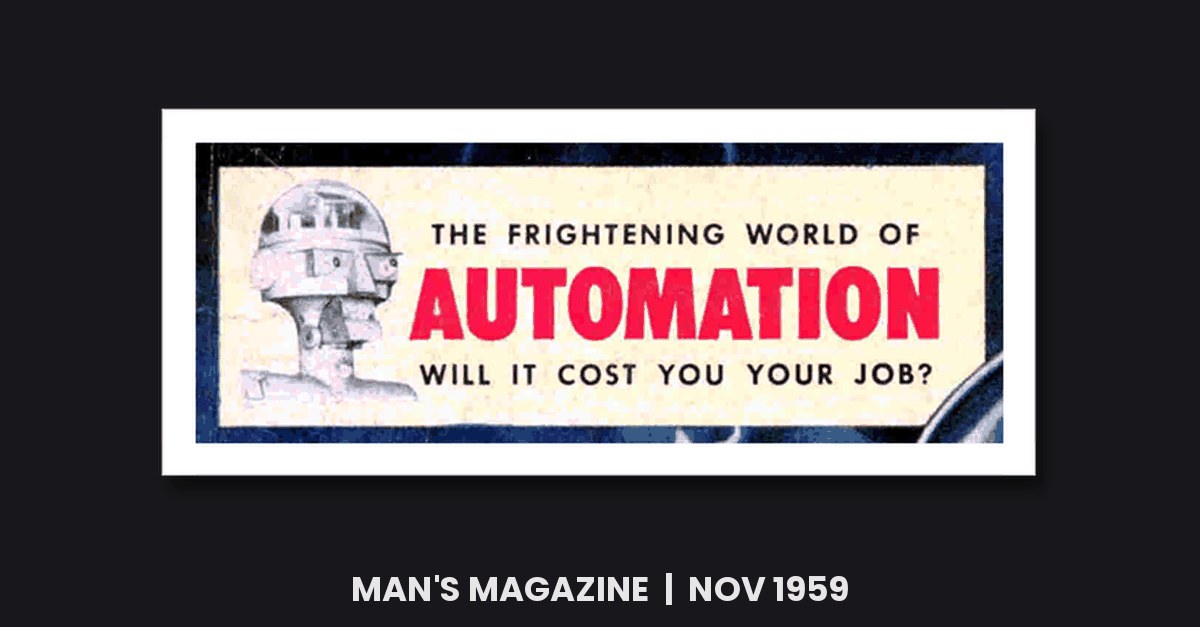
The fear was on newsstands before Time picked it up. The November 1959 issue of Man's Magazine, a pulp for blue-collar men, ran an inset on its cover reading "The Frightening World of Automation. Will It Cost You Your Job?" The Men's Adventure Magazines blog shows the cover and notes the article mixed real facts about automation devices with scary guesses about hundreds of thousands of people losing their jobs.
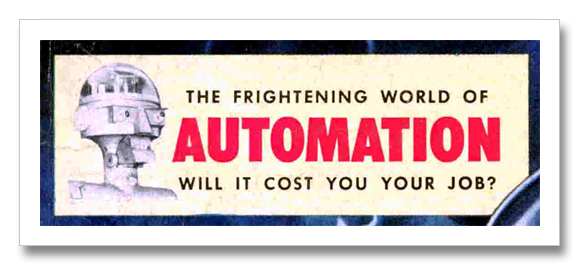
Man's Magazine, Nov. 1959. Cover shown for commentary.
The cover's main painting was an eye-patched pilot, and the automation question got a small box in the corner. Still, a magazine like that doesn't run the headline unless readers are already worried.
1961: the automation jobless
On Feb. 24, 1961, Time ran a Business story called The Automation Jobless. Unemployment had jumped, and 5.4 million Americans were out of work. Time even called automation an old scare word, so this was already a rerun.
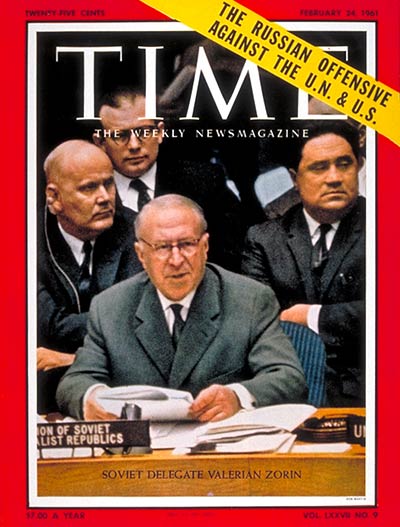
Time, Feb. 24, 1961. Cover shown for commentary.
The numbers were vivid. Chemical output was up 27% since 1956 while production jobs were down 3%. The Census Bureau needed 50 people for tabulations that took 4,100 statisticians in 1950. Banks were buying machines to process checks, and 1 expert ranked automation the nation's 2nd most important problem, right behind peace.
The line that stuck with me came from a congressman. His worry was less the worker who gets fired than "the worker who is not hired."
One more detail. That issue's cover was Soviet diplomat Valerian Zorin, not a machine. Automation was a back-of-the-book worry, not yet a headline.
1965: the computer gets the cover
4 years later the machine made it to the front. Time's April 2, 1965 cover, painted by Boris Artzybasheff, shows a robot-like computer with tape reels for eyes sitting in front of a giant brain. Its arms hold a phone and feed paper into slots, and a crowd of office workers is buried in paper at its feet.
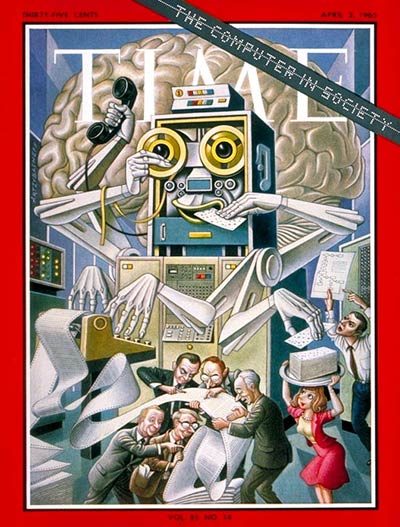
Time, Apr. 2, 1965. Cover shown for commentary.
The story inside, The Cybernated Generation, went big in both directions. Some radical prophets foresaw a day when as little as 2% of the workforce would be employed. An IBM economist figured on a 20-hour work week within a century.
In the same article, Time also said every major technology since the Industrial Revolution had caused unemployment, and society had adjusted each time. It added that computers so far had changed the type of jobs more than the number of them.
1965: Newsweek's challenge of automation
Time wasn't alone that year. In January 1965 Newsweek ran its own cover story, "The Challenge of Automation." I haven't found the original, so this comes from a 2017 column by Kevin Maney that quotes it. The story said New York City had 5,000 fewer elevator operators than in 1960 because of automatic elevators, and it wondered whether losing work would make people sick.
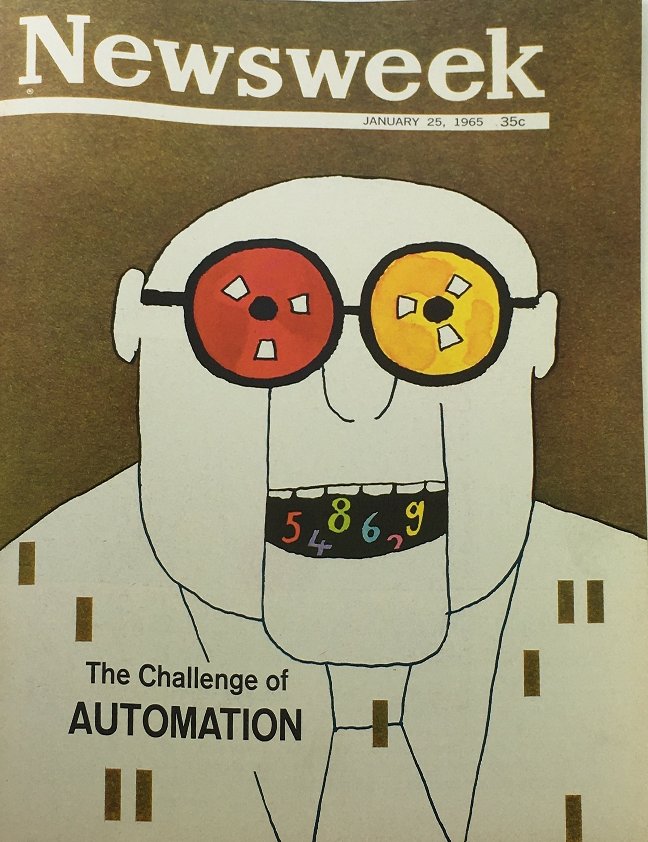
Newsweek, Jan. 25, 1965. Cover shown for commentary.
Newsweek said America could end up in a place where "the livin' is easy," if it could adjust. Maney's point is that the experts got the gadgets right and the easy living wrong. I'd add that the same story worried about people's need to work, which is a lot like today's universal basic income argument.
1966: the commission looks at the data
Washington took the fear seriously. President Johnson set up a national commission on technology and automation, and it reported in February 1966, when unemployment had already fallen to 3.8%. The commission blamed the earlier high unemployment on rising productivity, a growing labor force and weak demand, not on machines. Its summary has been quoted ever since: "technology eliminates jobs, not work." It pointed to the economy's response to expansionary fiscal policy as proof, so the happy ending had help.
The 1966 commission did not say nobody got hurt. It said particular workers in particular places lost jobs, and it asked for retraining and an income floor.
1978: the 1970s were quieter, and Time was upbeat
The 1970s are the gap in this story, in what I could read. The economy had oil shocks and inflation to worry about, and Bureau of Labor Statistics figures show productivity growth slowing to 1.2% a year from 1973 to 1979, so machines weren't obviously taking work faster than anyone could keep up. Time's Feb. 20, 1978 piece, The Computer Society, leaned the other way entirely. It predicted home computers that would run washing machines and a robot vacuum cleaner, and a machine that would rinse and stack the dishes.
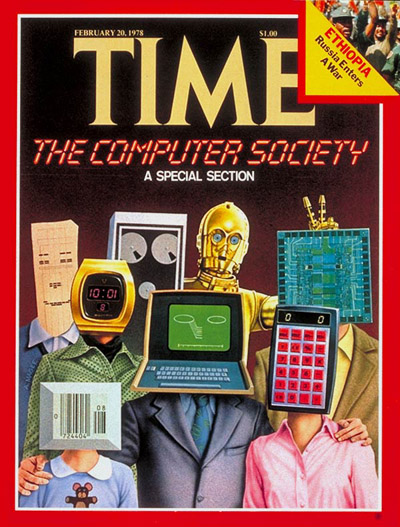
Time, Feb. 20, 1978. Cover shown for commentary.
In the US the computer arrived as a gadget before it arrived as a threat. Time's 1982 Machine of the Year story says personal computer sales were 724,000 in 1980, so the fear in the next section had a product to attach to. Whether inflation crowded the worry out is my guess. I can't prove it from what I read.
1981: the steel-collar worker
The fear got a new face in the 1980s, and it was a robot. A February 1981 Christian Science Monitor story said unions were worried about "steel-collar" workers, and that more than 5,000 robots were already working in US factories. General Motors expected about 14,000 by the end of the decade. Chrysler had replaced 200 welders at 1 plant with 50 robots. 1 union charged that General Electric's plans could replace 1/2 of its 37,000 assembly workers.

The Christian Science Monitor, Feb. 11, 1981. Headline shown for commentary.
Unions warned of large-scale, permanent unemployment, and a GE official said robots would open up tens of thousands of new jobs. Same facts, opposite forecasts, and nobody could settle it yet.
1982: Leontief says workers will go the way of the horse
Wassily Leontief won a Nobel Prize in economics, and in September 1982 he wrote a Scientific American essay arguing the past was no longer a guide. Machines that replaced muscle were being followed by machines that replaced the nervous system, he said, in offices as well as factories. As the Conversable Economist summarized it, he compared workers to horses, which lost their jobs to tractors without ever getting a vote.
Leontief predicted steadily rising unemployment, and that part did not happen. The same post notes that unemployment has dipped to 5.5% or lower in several stretches since 1982. What did show up was the 2nd half of his worry, wage inequality and a squeeze on lower-skilled work.
1983: Time calls it the New Economy
Time's May 30, 1983 cover story, The New Economy, caught the mood. Unemployment was 10.2%, 211,000 autoworkers were on indefinite layoff, and 2,800 robots were already on auto assembly lines. It quoted Leontief, and it quoted John Diebold, the management consultant whose 1952 book made the word automation familiar. Diebold said people blame automation at the bottom of every recession and forget about it a couple of years later.
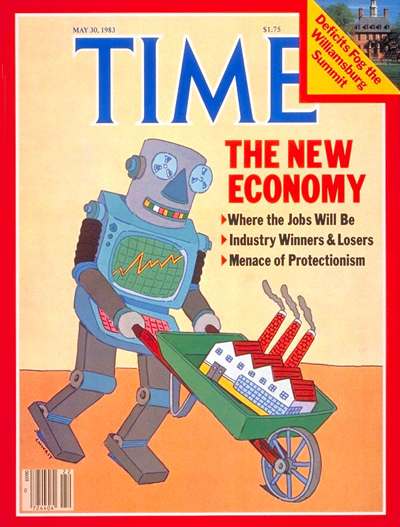
Time, May 30, 1983. Cover shown for commentary.
Time's own forecast was mixed, and it held up better than the extremes. It expected manufacturing to shrink, services to grow, and middle-aged factory workers to struggle to make the jump. It also said retraining would become a permanent part of working life. And it named foreign competition and the recession as the biggest causes of the pain, with technology as an accelerant.
1995: Rifkin says this time is different
Jeremy Rifkin published The End of Work in 1995, and a New York Times story that year quoted him warning that information technology threatened mass unemployment and social unrest. His argument was that technology had always destroyed jobs and created more of them, but this time it wouldn't. He pushed for a 30-hour work week.

The New York Times, Jan. 1, 1995, as summarized by Elon University's Imagining the Internet project. Shown for commentary.
Every round has someone saying this time is different. Maybe, just maybe, one of them will be right. The record so far isn't kind. James Bessen looked at the 3 decades after the personal computer arrived and found that the computer-heavy occupation groups grew faster than the overall labor force. Only manufacturing lost jobs on net, about 5 million over those 3 decades.
1996: the internet will cut out the middleman
The internet had a jobs fear of its own, and it was the same shape as the automation one. An Oct. 21, 1996 American Banker piece described a popular idea that the internet would be the ultimate destroyer of sales agents, brokers and middlemen. The article was skeptical of that idea, and I could only read its opening before the paywall.
American Banker, Oct. 21, 1996. Headline shown for commentary.
So what happened? For 1 job it came true. The Bureau of Labor Statistics put travel agents at about 74,100 in 2014, and its handbook now shows 61,500 for 2025. That's the "booking" job going online. I couldn't read a sourced 1990s starting count, so I'm not claiming the full drop.
But it wasn't the whole economy. Matt Sigelman, who tracks job postings, wrote in 2025 that the internet wasn't a huge job killer overall, though for some occupations it was a cliff. His example is that travel agents did 1 core task, booking, so the internet could replace the whole job. Most jobs are bundles of judgment, coordination and hands-on work, and the internet replaced only parts. He also says the new jobs showed up in unexpected places, like barbers with booking links, nurses on telehealth and delivery drivers.
1995 to 2000: productivity takes off, and so does the economy
Here's the decade that tested the fear. Rifkin's book came out in 1995, and that's about when American productivity sped up. Bureau of Labor Statistics figures show output per hour in the nonfarm business sector grew 1.5% a year from 1990 to 1995 and 2.5% a year from 1995 to 2000, against 1.4% for 1979 to 1990. Economist Robert Gordon, in a 2000 briefing for the Congressional Budget Office, noted that productivity had grown at barely 1 percent a year for more than 2 decades after 1973, then nearly 3 percent a year over 1996 to 1999. Unemployment reached 3.9% in April 2000.
Productivity rose throughout the 1990s, and so did prosperity. I'm not claiming one caused the other. Those are 2 lines moving together, and plenty of other things were going on in that decade. But the machines got faster at work and the jobs didn't disappear, and that's the opposite of what the end-of-work books predicted.
2011: Race Against the Machine
By the early 2010s the economy was growing again and hiring wasn't. Bloomberg reported in January 2012 that the US was producing almost 1/4 more than in 1999 with almost the same number of workers. MIT's Erik Brynjolfsson and Andrew McAfee, in their book Race Against the Machine, called it the start of a "Great Restructuring" that was hollowing out the labor market. The article also quotes economist James Hamilton calling that nonsense, and pointing out that farm work went from 41 percent of American jobs in 1900 to under 2 percent, and the ex-farm workers found new jobs.
The unemployment half of the fear did not play out. BLS's unemployment chart, which starts in 2006, shows a low of 3.4 percent. Here's the catch for me: the book was mostly about wages and inequality, not mass joblessness, so low unemployment doesn't settle it. I'd call this one split, and I believe the wage question is the live one.
2013: Oxford puts a number on it
Carl Benedikt Frey and Michael Osborne at Oxford looked at 702 occupations and estimated that about 47% of total US employment is at risk of computerisation. That number went everywhere.
A computer doing some tasks of a job is a long way from eliminating the job. Bessen made that point about the 47% in plain words: does it mean nearly 1/2 of all jobs are about to be eliminated? Not likely, he wrote.
Did the authors retract it? Not exactly, and the way they backed off is the interesting part. In a 2018 Oxford Martin blog post, Frey and Osborne wrote that their study "wasn't even a prediction." They called it an estimate of technical exposure that said nothing about the pace of job loss, and they added that the actual extent and pace would depend on other factors they left out.
They didn't take the 47% back. They reclassified it from a forecast to a measure of what's technically possible. They also argued the 47% looked ordinary against the twentieth century, since over 40% of the workforce was in agriculture in 1900 and now it's under 2%. Meanwhile, rival estimates came in lower, 9% from a Mannheim study and 14% from the OECD. The headline was read as a prediction by almost everyone who repeated it, and the authors say that's not what they meant. I'd call that a partial retreat, and it's the pattern I'd expect from most futurists: the number stays on the record and the meaning shifts.
2014: the experts split down the middle
In 2014 Pew asked 1,896 technology experts whether AI and robotics would displace more jobs than they create by 2025. 48 percent said yes, and 52 percent said no. Pew is clear that it was an opt-in canvassing, not a representative survey. What I like about it is that both fears and the counter-fear sat in the same room at the same time. I haven't scored the 2025 answer, so I'm treating this as a snapshot of the argument, not a result.
Matt Kestian once said this to me about the job of predicting: "Futurist. What a great job. By the time the future happens, you're long dead." I believe that's the catch with forecasts like these. They're often wrong, and by the time anyone checks, the forecaster has moved on. Pew's 2025 question is now due, and I haven't scored it. That's my belief, not a finding.
2015: the ATM and the bank teller
The cleanest example I found is the bank teller. ATMs showed up in the 1970s, and over 400,000 are installed in the US today. Bessen found that teller jobs did not fall. Each branch needed fewer tellers, down from 20 to 13 between 1988 and 2004, but banks opened 43% more urban branches, so the jobs held. The job itself changed, with less cash handling and more relationship work.
The machine took over tasks, and the job got rearranged around whatever was left. Bessen didn't give the economy a clean bill of health, though. He found stagnant wages for ordinary workers and employers who couldn't hire people with the right skills.
2017: The New Yorker puts a panhandler on the cover
In October 2017 The New Yorker's money issue showed a young man with a dog sitting on a future Manhattan sidewalk while humanoid robots walk past. One of them drops nuts and bolts in his cup. Inverse described the cover, drawn by R. Kikuo Johnson, who said he wasn't worried about being replaced by a robot. The story inside followed workers at a Michigan factory who joked they were "meat robots," meaning they now assist the machines.
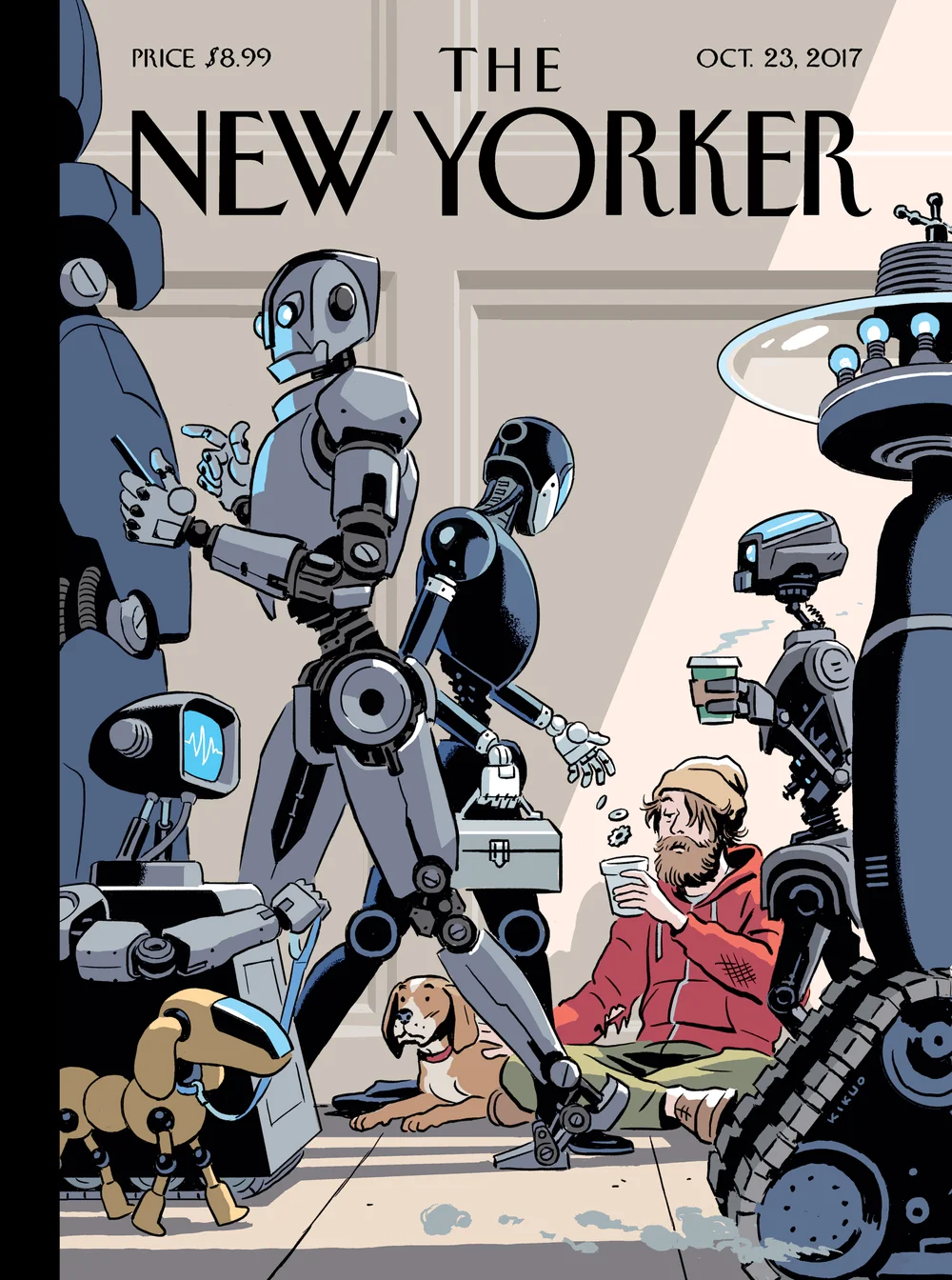
The New Yorker, Oct. 23, 2017. Cover art "Tech Support" by R. Kikuo Johnson. Shown for commentary.
This is the 1st cover in the pile where the people are the ones asking for money.
2018: McKinsey counts 400 million
The McKinsey Global Institute ran the numbers worldwide. Its 2018 briefing said about 15% of the global workforce, around 400 million workers, could be displaced by automation between 2016 and 2030 in its midpoint scenario. The fastest scenario hit 800 million. In advanced economies like the US, the midpoint was 20% to 25% of the workforce.
The same report counted new demand for 555 million to 890 million jobs, more than offsetting the losses, and the scary number gets the headline. Those are scenarios, not measurements, so I'd hold both loosely. McKinsey also warned about pressure on middle wages.
The World Economic Forum's 2025 jobs report lands in a similar place. Its employer survey projects 170 million new jobs and 92 million displaced worldwide by 2030, a net gain of 78 million. That's expectations, not measurement. It also has one fresh warning: graphic designers and legal secretaries show up just outside the fastest-declining list for the 1st time, which the report says may show AI's growing reach into knowledge work.
2026: where things stand
The economy-wide fear has kept missing, and so far it has missed again. The latest Bureau of Labor Statistics report has October 2026 unemployment at 4.1% and payrolls up 165,000 for the month, with unemployment in a narrow 4.1% to 4.3% range since March. And a Stanford team studying payroll data through June 2026 found no evidence of widespread, economy-wide job displacement from generative AI.
Here's the data that cuts against me. Challenger, Gray & Christmas tracks the reasons employers give when they announce layoffs, and its October report says AI was cited in 121,401 announced job cuts so far in 2026, about 20% of all cuts and more than double the 54,836 for all of 2025. The layoff announcements are the best evidence against me, because AI was the most-cited reason through the spring and summer. 2 cautions from the same report. Total announced cuts are down 44% from last year, and AI was cited for just 1,265 cuts in October, its lowest month of the year. And these are the reasons companies give in their announcements, not a measurement of what caused each cut. Yale's Budget Lab and Brookings reached a similar view in 2025, finding no discernible disruption to the broader labor market 33 months after ChatGPT, though they said that tells us nothing about the future. What the BLS report does show is slow hiring: payrolls averaged 48,000 a month over the prior 12 months before October's 165,000. That fits my front-door reading better than it fits a layoff wave, but that's my read.
That leaves a puzzle. Employers blame AI for cuts and still struggle to find its value. I believe both can be true at once, and that's my belief, not a finding. A layoff is a budget decision made today, and the proof that AI works shows up quarters later, if it does. I believe companies are moving capital toward AI to lift their return on invested capital, and headcount is where they find the money. Who wants to tell an earnings call that demand is down? "AI" sounds better. Some may be cutting past the fat and into the muscle. And the executives announcing the cuts may not know yet which questions to ask their teams to tell whether AI is working. A Lightcast economist says rollouts fail when they never define the work they're meant to change, which fits that last part. I don't have data on the rest, so treat it as a hypothesis.
2026: the part that doesn't match
The same Stanford paper has a 2nd finding, and it's the one I can't shrug off. Employment of workers ages 22 to 25 in AI-exposed jobs is now 19% below where it would be if it had kept pace with their less-exposed peers. Experienced workers in those same jobs show no comparable gap. The authors say the adjustment runs mostly through reduced hiring, not more firings, and the declines concentrate where AI automates tasks rather than helps people do them.
Remember the congressman in 1961 and the worker who is not hired? His worry was broader, about the whole economy and unskilled workers. But the 2026 data lands in a similar spot: hiring.
There are fair reasons to hold this loosely. The authors call these early, descriptive indicators, not causal estimates. The gap shrinks when they control for education, some of the trends were already diverging before generative AI, and the pattern is stronger in their payroll sample than in national surveys. So treat this as a hypothesis worth watching. The strongest challenge to my reading is that nothing guarantees the 1960s ending repeats, since that recovery leaned on government demand. The one place the old story might not repeat is the 1st rung of the ladder.
The authors have added 2 cautions of their own. In a February 2026 note, they say that with the strictest controls the decline for the most exposed young workers becomes significant only in 2024, so the earlier decline is likely partly something else, and that they don't believe AI is the sole cause. They also say interest rates are a poor explanation, because the most AI-exposed jobs are less sensitive to rates than average. Yale's Budget Lab, using a different method, found that the gap between recent graduates' occupations and older workers' stayed in a narrow band since January 2021, which suggests the trend may predate ChatGPT, though it warned about small samples. So the entry-level gap is real in Stanford's payroll data and unproven as an AI effect. I'd still watch it, and I'd still call it my hypothesis.
So what actually happened?
Here's each fear next to the record. I only scored what the sources above support.
| Year | The fear | What happened |
|---|---|---|
| 1961 and 1965 | Automation would leave a huge jobless class, maybe only 2% of the workforce employed | Unemployment was down to 3.8% by 1966, and the commission blamed demand and productivity, not machines. The 20-hour week is still ahead of us, so that one's open until 2065. |
| 1982 | Leontief: steadily rising unemployment | Missed. Unemployment dipped to 5.5% or lower in several stretches since. Wage inequality is the part that showed up. |
| 1995 | Rifkin: the end of work, a 30-hour week | Missed. Unemployment hit 3.9% in April 2000 and was 4.1% in October 2026. |
| 1996 | The internet will wipe out the middleman | Hit 1 job. Travel agents fell to 61,500, but Sigelman says the internet wasn't a huge job killer overall. |
| 2013 | Oxford: 47% of jobs exposed | The authors say it was never a prediction. Unemployment is 4.1%, but hiring for 22 to 25 year olds in AI-exposed jobs is 19% below trend. |
| 2018 | McKinsey: 400 million displaced by 2030 | Scenarios, not measurements. Too early to score. |
| 2011 | Race Against the Machine: a Great Restructuring hollowing out the labor market | Split. Unemployment fell to a low of 3.4%, but the book was about wages, and wages are the live question. |
| 2014 | Pew experts: 48% said AI and robots would displace more jobs than they create by 2025 | Not scored. A snapshot of the argument from an opt-in canvassing. |
| 2026 | AI is why employers are cutting jobs | Open. AI was cited in about 20% of announced cuts, but total cuts are down 44% and these are stated reasons, not measured causes. |
The economy-wide fear mostly missed whenever it could be checked, and the narrow fear about 1 job hit a few times. That's the pattern I see, and it's my read, not a law. The open question is whether 2026 is the exception, and the entry-level hiring data is the only place it might be.
2026: A demand signal that arrives before the orders
Here's a live example of data outside the shopping cart. As of this week, the Los Angeles Chargers are 0-8 with a point differential of -98, the only winless team in the NFL. Nobody saw that coming. Sports Illustrated noted the team swung big in the offseason on a new offensive coordinator and a franchise quarterback, and Newsweek reported that most pundits expected them to emerge as obvious AFC contenders.
Now think like a licensed apparel supply chain. Jerseys, hoodies and caps are designed, manufactured and wholesaled months before the 1st snap, sized to the demand a team is expected to generate. The inventory was built for a contender. The season is telling a different story, and the standings are a demand signal that arrives weeks before the sell-through data does. A planner who watches the gap between preseason expectation and actual record can pull back reorders, shift allocation to teams that are surprising on the upside, and mark down early instead of late.
The evidence that this is real is thinner than you'd think. I did not find a published study tying a pro team's weekly record to licensed merchandise sales. What exists points in a direction without proving the size of it. YipitData reported that NFL Shop run-up sales for the 2026 Super Bowl fell year over year, concentrated in the participating teams. Academic work on team record and fan loyalty found that winning lifts home attendance, which is a 1st cousin of merchandise demand, not the same thing.
And there's data that complicates the story. Justin Herbert ranked 31st on the NFLPA's year-end player sales list, the only Chargers player in the top 50, while Detroit, Philadelphia and Kansas City each had several. Star power, market size and brand carry sales independent of the record. A losing team with one famous quarterback doesn't behave like a losing team without one. So the signal is not "losing means selling less." It is the surprise, meaning the gap between what the supply chain planned for and what the team is doing, filtered through who the fans are buying.
Now compare that with what I saw while shopping. My presumption, and it's a belief, is that demand for a team's gear goes up as the team wins more. The Brewers swept the Dodgers to win the pennant on October 15, and the signs of demand were public from that day on: the best record in baseball, a pennant in a sweep, a World Series opponent about to be set. At about 8:40 PM on Saturday, October 17, with the Rays and Guardians playing ALCS Game 4 to see who the Brewers would face, I went looking for a patched World Series hat. The "ships by" dates and day ranges at cart and checkout were opaque, but the promise date I worked out from them was November 7. The Brewers won the Series on October 28, 10 days before that hat could reach my door. This is an industry problem: a manufacturer has to predict demand before the demand arrives, and the champions product can't exist until the games are played. The standings are public weeks ahead, so a licensed apparel maker that watches them, and not just the orders, can decide earlier what to make and where to put it.
What I believe: this is exactly where machines and humans split the work. The machine can ingest standings, point differentials, injuries and schedule strength every week. The human knows whether the fanbase is loyal or fair-weather, whether the quarterback is a draw on his own, and whether a coaching change is coming that resets the story. That's demand sensing from a data source most shopping models never look at.
What I believe
This is my opinion, not a finding. I believe we're all watching for layoffs while the real action is at the front door. The 1961 story and the 2026 data both say the thing to watch is who gets hired.
Every cover in this piece, from the 1959 pulp to the 2017 panhandler, carries the same hidden assumption. It's zero-sum thinking, the idea that there's a fixed pile of work and a machine taking some leaves less for us. If the tedious work of today gets automated tomorrow, the work we do then is the strategic work we never got around to yesterday.
I also believe technology is the reason we climb at all. Maslow's hierarchy of needs starts with food, shelter and safety, and it's technology that keeps covering those bottom rungs so more of us can spend time on the upper ones. His ladder isn't a strict order, so take it as a way of thinking, not a law. Still, the magazines kept warning about the thing handing us the next rung.
Here's the belief underneath all of it. I believe technology and automation make our lives easier, safer and more enjoyable, and they help each of us realize our potential. That's my read of the long run, not a measurement. The couch numbers further down are the fair challenge to the "more enjoyable" part, and the 2026 hiring data is the challenge to the "potential" part.
Here's my guess about the anxiety. Maybe many of us don't know what the strategic work is, so a machine taking the tedious work feels like it's taking our reason to show up. I haven't found data on that, so it's a hunch.
Try it at home. Say the lawn, the snow, the dishes and the vacuuming all get automated. What do we do with the hours? The latest Bureau of Labor Statistics time use survey says Americans already average 5.2 hours of leisure a day, and 1/2 of it, 2.6 hours, is watching TV. Reading for fun averages 16 minutes. Games and leisure computer time went from 25 minutes a day in 2015 to 37 minutes in 2025.
So far, free time mostly goes to the couch, not to investing or the strategic backlog. And the history is humbling. Economist Valerie Ramey found that washing machines and electricity had little effect on housework hours before 1965, and that combined home production hours have stayed roughly constant since 1900. Maybe we raise the standard instead, more laundry and a cleaner house. I'd like to think we'd do better with the time, but that's a belief, not a finding.
There's 1 story that pulls me the other way. In a 2010 TED talk, the late Swedish doctor Hans Rosling described the day his mother loaded their 1st washing machine. He was 4. His parents had saved for years to buy it, and his grandmother, who had heated water over a fire and hand-washed laundry for 7 children, was invited to watch. She pushed the button herself and then pulled up a chair and sat through the entire wash cycle.
His mother's explanation of the magic was simple: the machine does the work, so now they could go to the library. The laundry went in and books came out. She read to him, and that's where he says his career as a professor started. She also taught herself English and read novel after novel.
It's 1 family, and it's an anecdote, not data. Still, it's the best answer I've found to "what would we do with the time." Rosling said that in 2010 most of the world's women were still washing by hand.
The catch is that backlog work only turns into jobs if someone pays for it, and the tedious work is how juniors learn. Which is why I keep landing on the front door.
Time's 1961 piece had a 2nd warning I keep thinking about. A California retraining program had drawn only 100 applicants in 6 months, and a Michigan official asked whether a job would be waiting once people finished retraining. That's still the right question for any "just learn AI" advice, mine included.
Still, I believe retraining is a fact of professional life now. If you're not learning or growing, you're shrinking. That's my opinion, and I'm not citing a study for it. The 1961 question about whether a job waits at the end is the fair challenge, and the answer is that nobody can promise it. But standing still guarantees you won't be ready for one.
Here's where I think people go next. Take demand planning at a retailer. A machine can sense that demand is moving, but it can't tell you why. A planner knows a competitor just had a recall, or that last year's pattern is useless because the world changed. The valuable work is the why and the what-to-do-about-it, with the machine doing the sensing.
One more thing, because it's the best case against me. Offshoring was labor arbitrage: the same work costs $x in one place and $x-y in another, and near-free telecommunications made the move possible. That trade is capped by the wage gap, and a human still does the job somewhere. AI has no spread to chase, because the machine is cheap in both places. That's why I think this wave deserves a harder look than the ones before it, and why the "what the machines can't do" question matters more now. It's my belief, and I could be wrong.
The best part comes after that. When a planner overrides the forecast and writes down the reason, the machine learns from it. The human's judgment compounds instead of getting replaced.
The catch is that "machines can't" is a moving line, and this article is full of people who drew it in the wrong place. Models already forecast new products from lookalikes and read the news for signals. So I test every human advantage by asking whether it's durable or just where the tools are today. The 2 I'd bet on are owning the trade-off between stockouts and overstock, and noticing demand that never got recorded, like the customer who left because the shelf was empty. Both depend on accountability and being there, not on data. That's a belief, not a finding.
So what can you do about it, and what am I doing?
Learning gets harder as we age. That's my belief, and I feel it. It doesn't excuse any of us from working at it and growing. It just means we have to work at it on purpose.
The research is split, and I'll give you both halves. A National Institute of Neurological Disorders and Stroke scientist found that the amount learned on a new typing task is lower with age, starting in the 41 to 50 group. The same report describes a University of Chicago finding that older adults gather information faster than younger ones. And in a small UC Riverside study of 33 people with a median age near 67, learning several new skills at once raised cognitive scores a year later, though the time commitment was about 15 hours a week. So it gets harder, and it's still worth doing.
Here's what I'm doing. I view AI as a new programming surface, and I program IT. I hand it real problems and let it do the work, then check what comes back. The proof is in what those problems produced: the value created, the expenses I've reduced and the expense ratios I've reduced. I'd rather show you a result than tell you I'm learning.
Here's my hypothesis for 2026, and it's a belief: people entering the professional market will need to show AI fluency in their search, and the employers they're hoping to join need it badly. The data backs half of it. NACE found that more than 1/3 of entry-level jobs now require AI skills, nearly triple the share 6 months earlier, and Stanford's payroll data shows 22 to 25 year olds in the most AI-exposed jobs losing ground. The other half is shakier. Strada surveyed nearly 1,500 executives and they ranked AI literacy last of the skills they weigh in a new grad, behind critical thinking, communication and real work experience. So AI skill gets you considered. Judgment and proof get you picked.
So what does "AI fluency" actually mean to the people doing the hiring? Nobody agrees yet, which is part of the problem. TestGorilla surveyed about 2,000 hiring experts, and they scattered across 4 different bars for the minimum. 37% set it at knowing what the tools are. 28% set it at using AI for simple tasks like drafting emails. 26% set it at completing core work with AI on their own and checking the results. 8% set it at redesigning how the work gets done. 59% of the organizations said they'd hired someone who interviewed well on AI and then couldn't apply it on the job. TestGorilla sells assessments, so weigh its framing accordingly. Even so, the dividing line in their data is the same one I'd draw: talking about AI is literacy, and doing real work with it, verifying the output and catching the errors, is fluency.
AI fluency is not demonstrated by a tailored resume. Show that you can solve a problem, and a prototype is one way to do it. Anyone can write "proficient in AI tools" on a page. A working prototype of a real problem, even a rough one, shows the judgment, the taste and the follow-through that employers say they want. That's my belief, and it's why I'd rather see a clunky prototype than a polished bullet point.
Here's mine: I like maps. I tested to see if I could write software in voice mode while driving. I wrote up how that went in 60 Minutes, Two Chores, One Live Prototype. The result is a live map with 19 layers of real data, and the code is public on GitHub for anyone to check. It's a prototype, not a product. That's the point.
So if you manage people, hire the junior person and teach them to use the tools. If you're the junior person, get good at the work the tools can't finish for you. Then check back in a few years and tell me I was wrong. I'd be happy to be.