What Would Our Agents Say About Us?
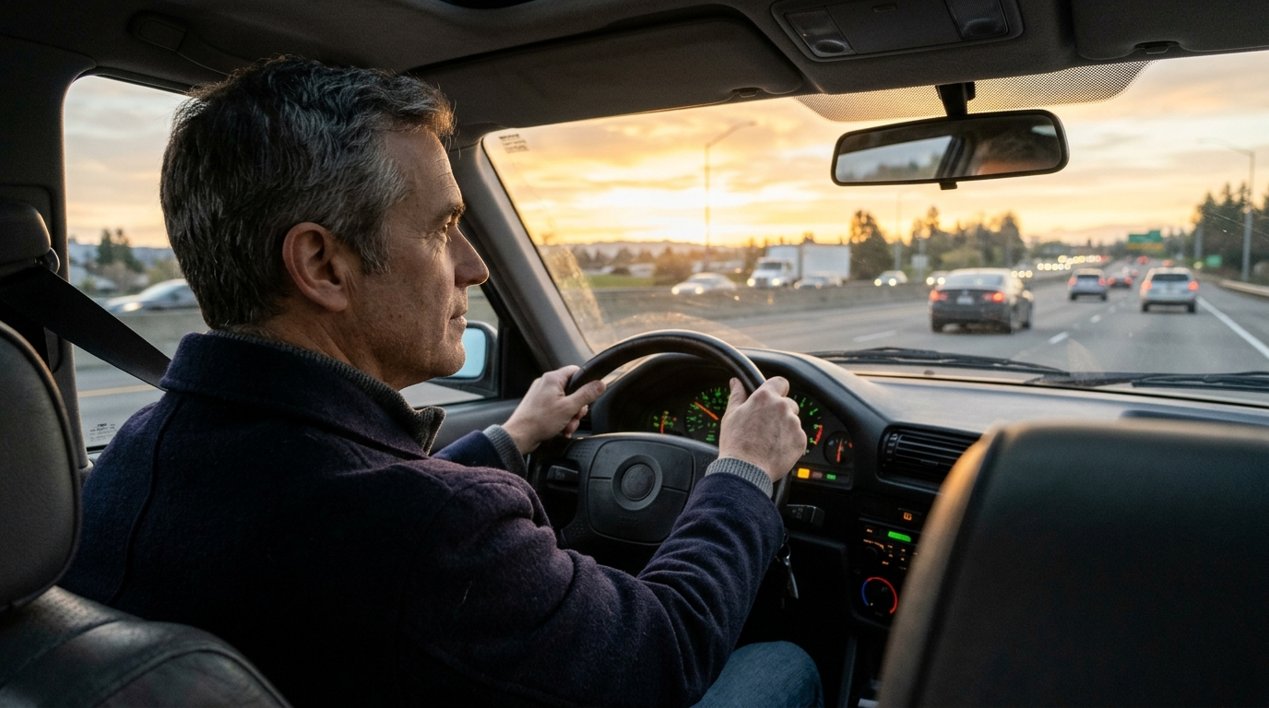
If agents could talk to each other, what would they say about each of us?
They can't. Not yet. But we can talk to them, and I do, mostly in the car.
Whatever your work model, the drive is real time, and voice mode is the first thing that has made it worth having. That's my belief, and the rest of this is why.
The commute is the argument
The return to office (RTO) debate is mostly a commute debate. People want their time back, and they're right to. The Census Bureau puts the average one-way commute at 26.4 minutes in 2022, after an all-time high of 27.6 in 2019. Round trip, that's 52.8 minutes. Go in three days a week and it's 158 minutes, a little over two and a half hours.
For most of my career I gave that time to the radio, a podcast I half heard, and hold music.
The cost isn't only the time. In a Gallup survey of 173,581 workers, those with commutes over 90 minutes were more likely to report worry the day before (40%, against 28% for commutes of 10 minutes or less). That's the extreme end, and the data is from 2010, when the average was 23 minutes.
What the office buys
The office has real evidence on its side, and it's narrower than the headlines. A New York Fed study of software engineers found engineers who sat together got 22% more feedback on their code, mostly the junior ones. It cost output. Programs written fell 23%, because the seniors were busy mentoring. Junior engineers on those teams were 5 points less likely to get a raise while the offices were open, then 7 points more likely once they closed. Training now, payoff later.
Equity analysts show something similar. Across 35 brokerage RTO mandates, typically two or three days a week, forecast errors fell 14.9%. The gains went to analysts 35 or younger, or with under three years of experience. Turnover rose from 15.2% to 17.6%, but only in 2020 and 2021.
Microsoft's own research found that going fully remote cut the share of collaboration time spent across groups by about 25%.
None of that proves a five day mandate lifts a company's results. It does say the office helps people who are learning, and teams that have to cross lines.
The strongest evidence against the office is a randomized trial. In a Nature study of 1,612 Trip.com employees, people assigned three office days instead of five quit a third less (4.8% against 7.2%) over six months. Performance reviews and promotions over the next two years showed no difference. The retention gain was biggest for non-managers, women and people with long commutes. Two caveats. It was one company in Shanghai, and a co-author is Trip.com's co-founder and chairman. Put together, that points to hybrid, which is the schedule my commute math assumes.
If the office has benefits and the commute is the price, the fair move is to lower the price. How RTO lands on families is a different argument, and a real one. I'm leaving it out of this piece.
The fair challenge is that a nicer commute doesn't fix a long one, and the real fix is no commute at all. Agreed. If you're fully remote there's no drive, and this isn't about you today. For everyone who still goes in, the drive stays.
Then I talked to it
One 60 minute drive, I scoped a product idea out loud with Claude in voice mode. No screen, no typing. By the time I got home the idea was sharp enough to hand to Claude Code, and it was built while I did two chores: a live map of Minneapolis with buses, trains, planes and weather moving on it.
Why the car works
A car is the one place where nothing competes for me. No inbox. No Slack. No tab I'll just check real quick. Hands on the wheel, eyes on the road, and a voice to think out loud with.
Podcasts and audiobooks have filled the drive for years, and I'm a fan. Neither one asks me a question back.
A conversation costs attention, and the research says so. The AAA Foundation rated listening to the radio a 1 on its distraction scale, talking on a phone a 2, and voice-activated email a 3. That research is from 2013 and covers in-car systems, so it can't tell me where voice mode lands. AAA's 2015 follow-up found drivers needed up to 27 seconds to return to baseline after a voice command. A January 2026 preprint on Gemini Live found its cognitive load similar to a hands-free call, with glances well under the two second threshold, but it was run for Google and isn't peer reviewed yet. Hands-free is not risk-free, and I'm making that trade knowingly. By that preprint, the load is about what a phone call already costs, and I never look at a screen. My rule is to talk, never type or read. If a conversation needs me to look at something, I wait until I arrive at my destination.
What I use it for
Rehearsing the hard conversation. I ask it to play the other side and push back, hard. Better to lose the argument at 7:10 AM in traffic than in the meeting at 9 AM.
Scoping the day before it starts. In my experience, talking through what matters, out loud, forces a clearer answer than a to-do list does. Saying it aloud helps it stick, too. In lab experiments, words spoken aloud were remembered better than words read silently. Fragments and all.
Getting the news. I use voice mode to learn about the topics I care about. Investing, earnings releases, capital markets, updates on specific countries. Then I ask it what I should be aware of, not what I want to be aware of.
Decompressing on the way home. The last ten minutes of the drive can be a reset, so work doesn't walk in the door with me. Maybe, just maybe, my family notices.
Continuity. It remembers what I said Tuesday and can pick it up Thursday. A drive stops being a one-off and turns into a standing appointment with something that has been paying attention.
Back to the question
So what would our agents say about us?
I guess they'd repeat what we told them in the car. Where we're stuck. The idea we haven't told anyone yet. In my experience people are surprisingly honest when it's just them, a windshield and a voice.
That's the part I keep thinking about. If agents ever do talk to each other, what I said at 7:10 AM goes with it. I don't know yet what that costs. I do know what it has given me: 158 minutes a week I used to spend on hold music.
Next time I'm on the freeway, I already know the first thing I'm going to ask.