You Are Not the CEO of Your Product
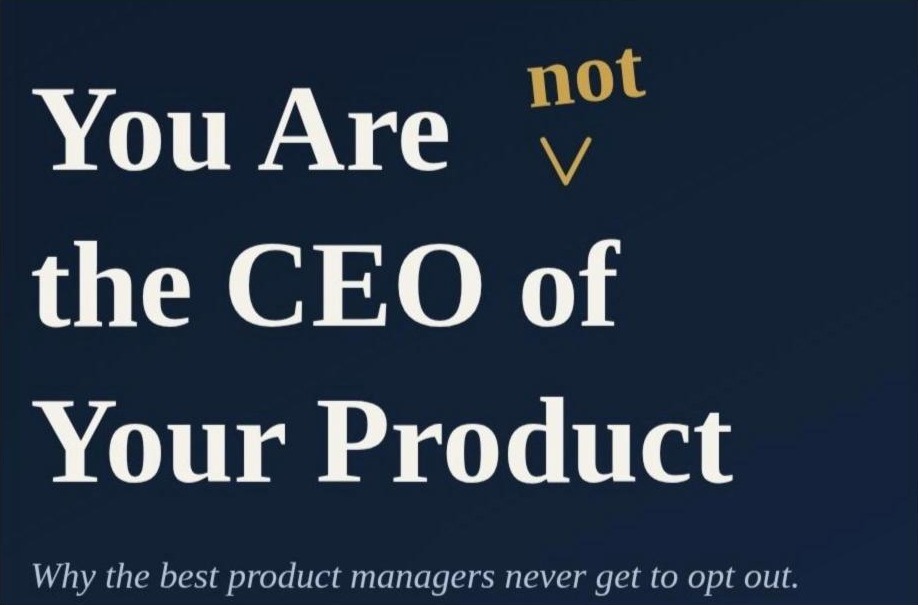
Or: why the best product managers never get to opt out.
Years ago, a technology executive I worked under told every product manager in the building: "You are the CEO of your product."
It was good advice, and most people heard it right. It meant own your outcomes, be accountable, stop waiting for someone to hand you a roadmap. But a metaphor is only as good as its reading, and some people heard something else. They heard sovereignty. The right to opt out of anything that didn't obviously serve their own patch.
Sometimes that was a clean refusal: a company priority came down, and a team said, in so many words, "I don't see how it helps my product, so we'll sit this one out." More often it was quieter and harder to fight. Another team would bring a legitimate cross-team request to a product group, get a warm and agreeable yes in the room, and then watch nothing happen. No refusal to escalate. Just a request that never made the roadmap. Passive non-delivery is the everyday form of opting out, and it's more corrosive than a clean no, because at least a clean no tells you where you stand.
Here's the problem with all of it. A real CEO doesn't get to opt out of the board's priorities. A CEO who told their board "I didn't find that initiative useful to my P&L, so we passed" would be gone by the end of the quarter. The whole point of the analogy is that the autonomy and the accountability are inseparable. The people who invoked "CEO of my product" to justify sitting out had kept the autonomy and quietly dropped the accountability. Exactly backwards.
The project is a signal
Walk into any boardroom in a soft quarter and you'll hear the same questions. Why isn't revenue growing the way we said? Why are expenses ahead of plan? When does the money we spent pay off?
I've been in those meetings. When executives commit to a number, they're held to it, and when the pressure lands, the organization doesn't respond with a leisurely bottoms-up process. It responds with a project. A commanded change, hard goals, a deadline, every relevant team expected to participate. The board isn't asking for volunteers.
This is where "aligned autonomy" meets reality, and where the product manager who treats the mandate as a tax on their real roadmap misses the biggest opportunity of their year. Because a project is a signal. It tells you precisely what the business values right now and where it will spend to get it. The right response isn't to ask whether to participate. It's to find a way to make your product part of the win.
And here's what never makes the announcement: the leader who funded the project often can't hand you a crisp list of the outcomes they're chasing. They have conviction, a budget, and a direction, and the specific metrics are fuzzy. That looks like a problem. It's the opening. The best product managers don't wait for the missing clarity, and don't quietly swap in their own pet agenda either. They help name the outcomes the leader is actually reaching for, propose the measures that would prove it worked, and deliver against them. That is strategic contribution flowing up, not just execution flowing down.
Why the mandate matters
There's a reason the mandate is worth more to you than it looks.
The highest-value work in most companies doesn't live inside any one product. It lives between products, connecting online inventory to physical stores, unifying an experience across channels, making an physical operation visible to a digital experience. That work needs many teams to move together, and no single product manager owns the whole surface. Which means any one team can kill it by saying "nope" - or, worse yet, saying nothing at all.
"CEO of your product" gave every team that veto. So companies systematically under-invest in the connective work that creates the most durable advantage, because it dies on the first local objection. The work that would move the enterprise most is the work pure autonomy is worst at delivering.
That reframes the whole "top-down project versus autonomous product" fight. A mandate isn't the enemy of product thinking. It's convening power your title never gave you. When leadership calls for the change, participation stops being optional, and the connective work finally gets done. The mandate hands you the one thing you could never get on your own authority: it makes the other teams show up.
I watched this for more than a decade in retail. Some of the most valuable things I helped ship, ship-from-store, curbside, flex work, the fulfillment routing that tied physical things to a digital experience, only happened because an enterprise mandate forced teams together that would never have aligned on their own. Left to autonomy, each died on the first veto. The mandate is what made them real. (That's its own story, and its own article.)
Keep your ideas ready
The answer to opting out is not becoming an order-taker.
When a company routes all its capital spending through projects, the risk flips. People stop opting out and start going passive, building the spec exactly as written, because that's where the money is and anything more feels unfunded. You've traded feature-factory-by-autonomy for feature-factory-by-mandate. Same passivity, new master.
It doesn't have to go that way, because a project funds an outcome, not a spec. The money is set aside to "reduce churn" or "launch a new capability," and the gap between that goal and how you actually build it is enormous and mostly unclaimed. That gap is where the entrepreneurial work lives. The product manager who rises asks: the project pays for X, but if we build X right, can we also unlock the Y we've wanted for two years and never had the will to fund?
The catch, so I'm being honest: this only survives when leadership funds outcomes, not blueprints. Lock every dollar to a pre-written spec and punish any deviation, and the spirit dies no matter how good your people are. So there's an ask upward, too. Fund the outcome. Trust the team to make it worth more than you asked.
Here's the habit that lets you actually seize the moment when it comes. For years I've kept a running inventory of ideas, well over a hundred, each a problem worth solving that the organization wasn't ready to fund yet. I didn't just list them. I tagged them by keyword and cross-referenced them, so it worked less like a notebook and more like a knowledge graph of solved-on-paper problems. When a business problem or an enterprise project appeared, I could query my own thinking against it and pull what was relevant.
One of those ideas, from 2018, got a cold reception when I floated it, and it went in the graph with the rest. Then the pandemic hit, and the exact problem it solved was suddenly everywhere. I pulled the write-up. We had a pilot running in three weeks. The idea was never the hard part. The mandate was what the idea had been waiting for, and the mandate arrives fast, on the enterprise's schedule and not yours. The people who catch that wave are the ones who already did the thinking, structured so they can find it, and can move the week the signal fires.
The same room, a different question
Turn "CEO of your product" right-side up, because the instinct behind it was sound. It was fighting passivity, order-taking, no ownership of outcomes. Those are real. The answer isn't to trade one passivity for another. A CEO owns their outcomes and delivers against the board, both at once, every day. The autonomy was never the problem. Opting out was.
I opened with a boardroom asking hard questions. Why isn't revenue growing? Why are expenses up? When does the money pay off?
Picture the same room a few quarters later, when the results have beaten expectations. Now the question is different: what do we have to thank for this? Same room, same people, the question inverted, from interrogation to credit.
The product manager who treated the mandate as a tax isn't in that answer. The one who read the signal, helped sharpen it, and pulled two years of deferred ambition along with a company-wide project is the reason the second question gets asked at all.
Let that answer be your contribution to the project.
First published on LinkedIn, August 28, 2026.