Your Point of Sale Is a Demand Engine
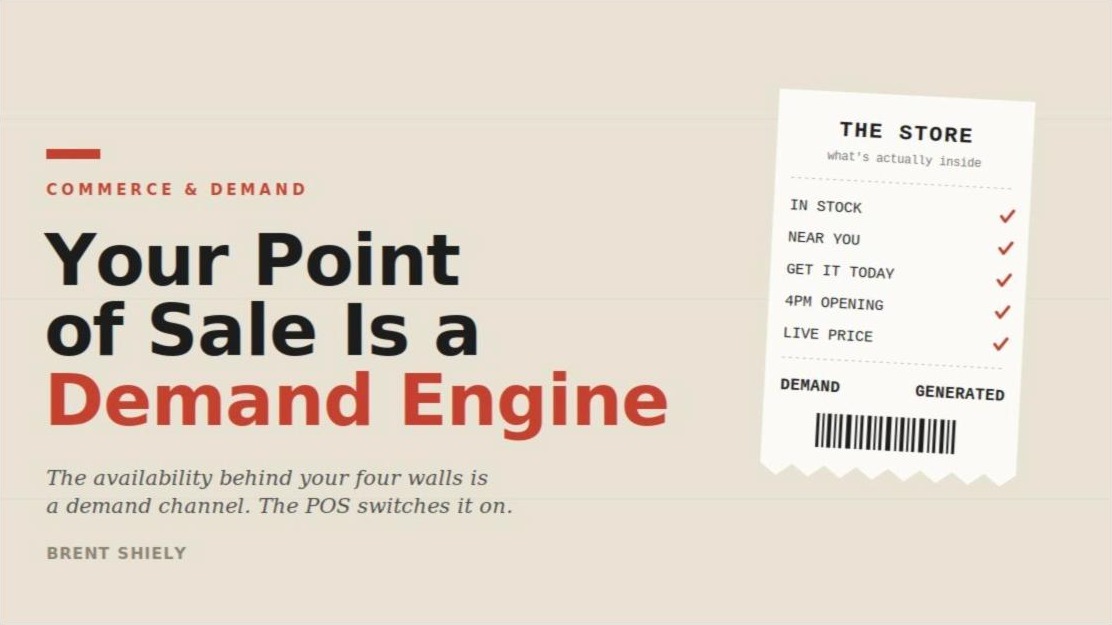
Here's something most merchants don't know. Right now, Google will put a store's in-stock products in front of nearby shoppers, with live local availability, across Search and Maps, for free. Not an ad. A free local listing that says "this place near you has this, right now." It works because of intent: someone searching "where can I get X near me" isn't browsing, they're ready. Google's own data says retailers who display local inventory see about 16% more organic impressions on their shopping offers, and pairing free listings with local inventory ads drives a 21% lift in store visits and a 9% lift in online conversion for in-store items. Google has been offering this, for free, since 2018. The listings and clicks are also free. Yup. Free.
The big retailers already treat this as table stakes. Search for a specific drill, refrigerator, or laptop near you and Home Depot, Lowe's, Walmart, and Target will each tell you which nearby store has it, in stock, right now. Google is pushing everyone else the same way: as of August 2026 it turns local inventory ads on by default for Shopping campaigns. But most smaller merchants haven't lit this up yet, the regional grocer, the furniture shop, the specialty and hardware stores, the independents, most restaurants, most service providers. Their stock and their offerings still sit silent behind the glass, invisible to the shopper standing three miles away asking their phone where to buy. Here's why they should change that.
This is really just an old retail instinct applied to a new map. Merchants have always gone where the traffic is, main street, then the mall, then the web. The traffic keeps moving, and right now it's moving into search results and AI assistants. So the rule hasn't changed, only the address has: as digital traffic grows, what you sell has to show up digitally, in full. A product detail page was only ever the first step of showing up, a picture and a price. The next step is telling the shopper what's actually available, where, and how fast they can have it, on whatever surface they happen to be asking.
And in 2026, the surfaces are multiplying. This stopped being just Google. The AI assistants are moving onto the same ground, at different speeds. ChatGPT now handles tens of millions of shopping queries a day, shows product cards organically rather than as paid ads, prefers live inventory and fresh pricing, and has begun adding local availability with a store finder near the center of the experience. Google is pushing the same shopping intelligence into Gemini. Claude has started surfacing product cards in its answers, and Meta is ramping commerce across Facebook and Instagram. The field is still churning, some players have advanced and at least one pulled its product cards back, but the direction is unmistakable. Physical SEO is becoming physical answer-engine optimization, and the shopper asking "what can I get near me right now" is asking it in more places every month.
Now look at almost any physical merchant, a restaurant, a boutique, an auto shop, a salon. They have physical proximity. They've almost all claimed a Google Business Profile, so they show up on Maps and collect ratings and reviews. But that profile tells you where they are and whether people liked them. It says nothing about what's actually available inside right now: the dish, the item in the size you want, the bouquet of flowers available for purchase, the open appointment at 4pm, the price. The entire offering sits silently behind the four walls. The high-intent search, whether it's typed into Google or asked of an AI assistant, finds the storefront but never the substance. Ask AI what's in stock near you today and it often can't tell you, because the merchant never published it, and an assistant with no visibility into store-by-store inventory will happily point the shopper somewhere else.
That gap is the opportunity. And the system that can close it is already sitting on the counter.
The POS already knows the truth
The point-of-sale platform is the one system that knows, in real time, what a merchant actually has: what's in stock, what's on the menu, what's bookable, at what price. It's the merchant's source of truth for availability. It just doesn't usually talk to the outside world.
That's the whole game. Connect that real-time truth to the surfaces where demand begins, Google first among them, and a small merchant gets something extraordinary: the silent storefront becomes a published, searchable, up-to-the-minute offer. The bakery's morning croissant count, the boutique's last two mediums, the shop's same-day tire fit, the salon's 4pm cancellation, each one becomes a reason for a nearby, ready-to-buy person to walk in or click buy.
This is not a new idea. It's a proven one. It's just never been within reach of the merchant on the corner.
The proof: what this looked like at enterprise scale
I spent a big part of my career building exactly this engine, at Best Buy, the hard way, before any of it came in a box.
The premise was simple and, at the time, contested: fulfillment isn't the thing that happens after the sale, it's what drives the sale. We set out to prove it.
We proved it, and Best Buy documented it in its own annual reports. In 2013 we piloted ship-from-store in 50 underperforming stores, if an item was out of stock online, find the nearest store that had it above a safety threshold and ship from there, then scaled it past 1,400 locations. Domestic online sales rose 20% the next fiscal year. That holiday season, an independent ratings service clocked Best Buy delivering faster than Amazon, three days to Amazon's four, crediting the store-shipping network. (The Motley Fool, Feb 2014) By 2020, that same backbone let the company move every store to curbside-only in 48 hours when the pandemic hit, retaining roughly 70% of sales with the doors closed and growing online sales more than 250% during that stretch. You don't build nationwide curbside in 48 hours. You switch on a backbone you spent years building. The demand engine built in ordinary times is what carried the company through the extraordinary one.
Making that real took genuine engineering. The same item used to tell different stories on different pages, because each page cached its own availability answer on its own clock, and a promise the site contradicts is a promise no one believes. So we built a fulfillment microservice that returned personalized availability, by item, store, and ZIP, in under half a second, and a shared component that rendered it consistently on any screen. Once every surface could ask one fast question and get one trustworthy answer, availability could live anywhere: on the product page, in search filters, at the top of the funnel. Nothing converts like "get it today," and nothing generates repeat demand like a promise that held.
That took a decade, a large team, and real capital. Which is exactly why the next part matters.
The democratization
What Best Buy had to build, a modern POS platform can increasingly deliver as a feature.
The merchant on the corner already has the two ingredients an enterprise retailer spent years assembling: a real-time record of what they have, sitting in their POS, and a high-intent audience searching nearby, now spread across Google and every AI assistant at once. What's been missing is the connective tissue between them. That's a platform problem, and it's a solvable one. The POS that publishes a merchant's real availability to the surfaces where demand originates turns every one of that merchant's SKUs, dishes, or appointment slots into physical SEO, without the merchant hiring an engineering team or even fully understanding what just happened for them.
There's a catch, and it's the reason this is harder than flipping a switch. Every one of these surfaces wants clean, structured, current data: correct attributes, consistent categories, fresh availability. Most merchant catalogs and menus are none of those things, they live in PDFs, spreadsheets, and the owner's head. Getting that raw mess into structured, machine-readable form, reliably and at scale, is its own hard problem, and it's exactly the kind of thing modern AI is finally good at. (That's a whole article of its own.) Solve the ingestion, and the merchant becomes eligible to be surfaced everywhere demand now begins.
This is the part of commerce I work on now, at US Bank, and it's why I find it more exciting than anything I built at enterprise scale. The enterprise version helped one company. The platform version can hand the same demand engine to hundreds of thousands of companies who never knew they had one. The croissant count, the last two medium blouses, the 4pm opening for a pedicure, all of it stops being a secret kept behind the four walls and becomes a signal that pulls the next customer in.
The demand was always there
Picture the merchant asking the question every owner asks after a good week: what drove that?
The honest answer usually isn't a campaign. It's that, for once, the right person found out at the right moment that the thing they wanted was right there, in stock, close by, ready. That's not marketing. That's availability, made visible.
For enterprises, exposing that truth took a decade of engineering. For everyone else, it's becoming a setting. The merchants who switch it on will generate demand they used to leave sitting silently on their shelves, surfaced across Google and the AI assistants that more shoppers now ask first, and their point of sale, the humble system that just rings up the sale, turns out to have been a demand engine the whole time.
First published on LinkedIn, September 7, 2026.